
High-Density LED Strip vs Standard LED Strip Lights
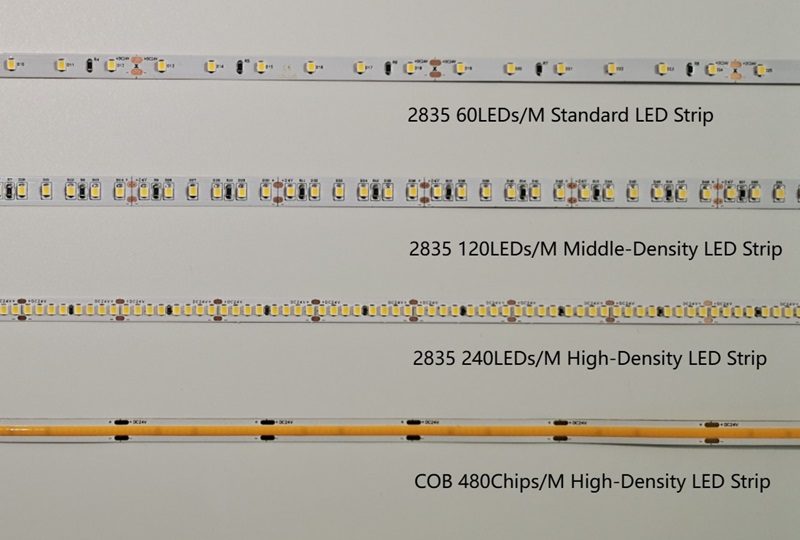
LED strip lights look simple—but for B2B buyers, LED density is one of the fastest ways to separate “it works” from “it looks and performs professional.” The number of LEDs per meter affects brightness, dot-free appearance, power planning, thermal design, pricing, and long-term reliability.
This guide explains the differences between High-Density LED Strip and Standard LED Strip Lights, and how to specify the right option for architectural and commercial projects.
What Is LED Density? (LED Count vs LEDs per Meter)
You’ll often see “300 LEDs” or “600 LEDs” on LED Strip specification. That’s usually LED count per reel (commonly a 5-meter / 16.4 ft roll). Density is more useful for design and procurement:
LED count: total LEDs on a reel (e.g., 300 LEDs per 5 m)
LED density: LEDs per meter (LEDs/m) or per foot (LEDs/ft)
Common densities:
30 / 60 / 120 LEDs per meter (≈ 9 / 18 / 36 LEDs per foot)
On a 5 m reel, that often corresponds to 150 / 300 / 600 total LEDs
A simple way to remember it:
More LEDs per meter = smaller spacing = smoother light

High-Density vs Standard LED Strips

| Feature | Standard Density LED Strip | High-Density LED Strip |
| Typical density | ~60 LEDs/m | 120–700 LEDs/m (and higher) |
| Visual appearance | “Dotted” points may show | Smoother, fewer hot spots |
| Best when strip is… | Hidden or indirect | Visible or close to surface |
| Typical use | Accent, decorative, concealed runs | Task lighting, shelves, mirrors, coves |
| Power & heat | Lower | Higher → needs better thermal design |
| Install depth needed | Often deeper diffusers to hide dots | Works in shallower profiles |
| Cost | Lower | Higher |
Rule of thumb:
If LEDs are visible or close to the lit surface, standard density can look “spotty.”
If you need a continuous light line, high density—or COB—is usually the safer spec.
Why High-Density LED Strips Look Better?
High-density strips place LEDs closer together (commonly 120–240 LEDs/m), which:
reduces visible “hot spots”
creates a smoother, more premium line of light
improves visual quality in coves, aluminum channels, and linear fixtures
Because spacing is smaller:
you can achieve “dot-free” appearance with shallower channels
you may need less diffuser depth, saving space in millwork and architectural details
High density is preferred for:
shelving and display lighting
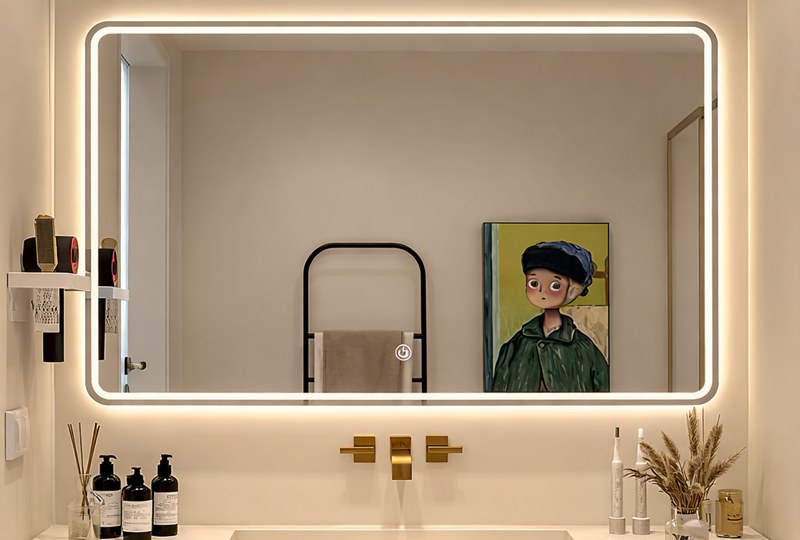
mirrors and vanities
signage edges and close viewing distances
More precise cutting and fitting
With more LEDs per meter, many products offer:
shorter cutting intervals
4. easier length matching and cleaner end-to-end connections with consistent brightness
How Density Affects Brightness, Power Draw, and Heat
All else equal (same LED type and drive conditions):
more LEDs per meter → more light per meter
However, not every high-density strip is brighter in practice. Some suppliers use:
higher-brightness LEDs at lower density, or
lower-brightness LEDs at higher density
…which can land at similar total output.
Power draw tends to rise with density:
more LEDs/m → more watts/m → more load on the driver
A practical example you’ll see in the market:
A “standard density” roll might use 300 diodes per 16.4 ft (5 m)
A high-density version might use 600 diodes per 16.4 ft
That doubling typically means you must plan for more power capacity. For instance, a 60W power adapter that can run two standard-density rolls may only run one high-density roll—depending on wattage per roll.
Density doesn’t directly change LED lifetime; heat and drive current do. But density influences both indirectly:
High density often means higher watts per meter → more heat along the strip
More heat raises LED junction temperature → faster lumen depreciation if not managed
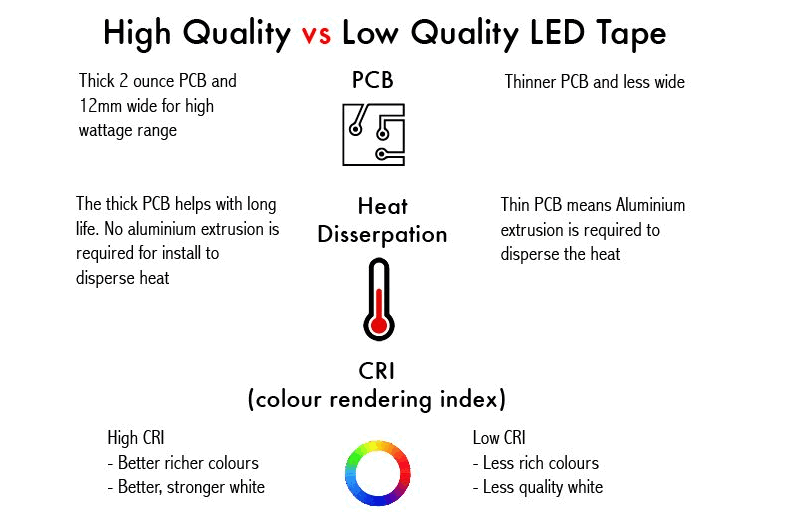
aluminum channels or heat-sinking mounting
appropriate tape/adhesive rated for temperature
avoid enclosing strips without airflow when power is high
The Most Popular High Density & COB LED Strip
Here are some of the most popular High Density and COB LED Strip options on the market.


SMD High-Density vs COB LED Strip: Which One Should You Specify?
Both high-density SMD strips and COB strips can deliver a “premium” look—but they win for different reasons. For B2B projects, the choice usually comes down to visual uniformity vs batch consistency and maximum brightness, plus a few practical engineering tradeoffs.

1. COB LED Strips (Chip-on-Board)
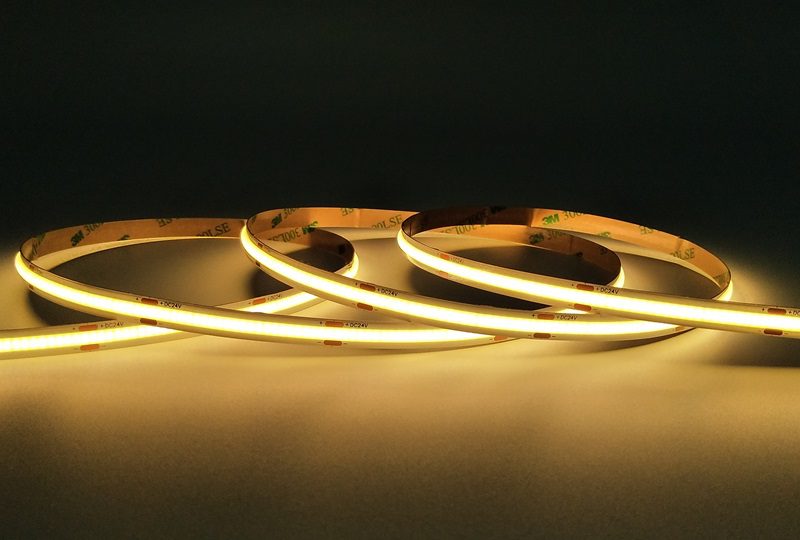
COB’s core advantage is an ultra-uniform, dot-free light line—even in shallow channels and with simple diffusers. In many markets today, COB can also be more cost-competitive than most traditional high-density SMD strips.
However, COB can introduce two common constraints in professional rollouts:
Batch-to-batch color consistency can be harder to control if the supply chain lacks a proper color-binning / “spectral sorting” workflow.
Voltage drop is often higher than conventional SMD strip designs, so long runs may require more frequent power injection or shorter feed lengths.
2. High-Density SMD LED Strips (e.g., 2835 / 5050 / 2216)
High-density SMD strips are the go-to option when you need higher power per meter and higher peak brightness, with stronger control over color consistency across production batches (assuming the manufacturer runs standard binning and quality processes).
The tradeoff is typically higher purchase cost compared with COB, especially when you specify premium bins, high CRI, tighter CCT tolerance, or higher wattage designs.
3. COB vs High-Density SMD LED Strip

| Dimension | COB LED Strip | High-Density SMD LED Strip |
| Primary advantage | Ultra-uniform, dot-free appearance | Higher achievable power & brightness |
| Typical “look” | Continuous, neon-like line | Very smooth at high density, but may still need the right diffuser depth |
| Price (typical market trend) | Often lower than many standard high-density SMD options | Often higher, especially for premium specs |
| Batch color consistency | Harder if no spectral sorting/binning workflow | Easier to keep consistent across batches with proper binning |
| Voltage drop over long runs | Often higher → shorter runs / more power injection | Often lower than COB at comparable setups (varies by design) |
| Best for | Direct-view, shallow profiles, “no dots allowed” | High-output task lighting, projects needing repeatable color across rollouts |
| Main risk to manage | Color variation across shipments; voltage drop planning | Higher upfront cost; thermal management at higher wattage |
Quick Spec Decision
Choose COB LED Srip when:
you need the cleanest dot-free line and want a cost-effective way to get a premium visual effect—and you can manage color variation risk with tighter supplier controls and plan for voltage drop.
Choose high-density SMD LED Stripwhen:
you need maximum brightness, higher W/m, and repeatable color consistency across multiple orders or multi-site deployments—even if the price is higher.
Pricing and Total Cost: Why Density Changes the Bill
In many LED strips, the LEDs themselves are the most expensive component, so density matters.
1. A simplified materials model often used in industry:
LEDs might cost $0.003–$0.008 each (varies widely by chip, binning, CRI, etc.)
the strip and assembly may be under $1 per meter in some cost structures
2. Example calculation:
If LEDs are $0.005 each:
30 LEDs/m → $0.150 LEDs + ~$1 assembly ≈ $1.15/m
60 LEDs/m → $0.3 LEDs + ~$1 assembly ≈ $1.3/m
120 LEDs/m → $0.6 LEDs + ~$1 assembly ≈ $1.6/m
240 LEDs/m → $1.2 LEDs + ~$1 assembly ≈ $2.2/m
Conclusion
COB and high-density SMD strips can both deliver professional-looking linear lighting, but they optimize for different priorities. COB is the best choice when your #1 requirement is an ultra-uniform, dot-free light line, and it is often more cost-effective than many traditional high-density SMD options—yet you should plan for higher voltage drop and take extra care with batch-to-batch color consistency if spectral sorting/binned workflow is limited.
High-density SMD is the better specification when you need higher wattage and higher peak brightness, and when your project requires repeatable color consistency across multiple batches or sites—with the tradeoff of a higher purchase price and the usual need for solid thermal design at higher W/m.
FAQ
1. Are high-density LED strips always better than standard density?
Not necessarily. High density is best when you need smooth, premium-looking illumination or higher output in visible installations. If the strip is hidden or used for indirect glow, standard density can be more cost-effective and still look great—especially with a proper diffuser. The best choice depends on viewing distance, diffuser depth, and project budget.
2. Do high-density LED strips require special installation?
They usually require more careful planning for power and heat. Because watts per meter are often higher, high-density strips may need larger drivers, better voltage drop management (shorter feeds or power injection), and improved heat dissipation using aluminum profiles. Proper installation helps maintain brightness consistency and extend product life.
3. Can standard LED strips be used for architectural lighting?
Yes, especially for concealed or indirect architectural lighting where the LEDs are not directly visible. With enough distance from the diffuser or reflective surface, standard density can look clean and professional. For direct-view lines or shallow profiles where dotting is obvious, high density or COB is usually a safer specification.
4. Is COB considered a high-density LED strip?
In most practical applications, yes. COB is designed to produce an ultra-uniform, dot-free light line using a dense micro-LED structure under a phosphor layer. It’s often selected when the requirement is “no dots allowed,” particularly for direct-view or shallow-channel designs.
5. How do I avoid visible dots in a shallow LED aluminum profile?
Use a higher-density strip or COB, and pair it with the right diffuser (frosted or micro-prismatic). Also keep the strip aligned inside the channel and avoid ultra-short viewing distances when possible. If the run is long, plan for voltage drop so the brightness remains uniform from start to end.
LED Light Sheets vs LED Strip Lights
COB LED Strip Passed 160hrs Thermal Shock Cycles Test
Related Article
Need an Instant Quote For Your Upcoming Projects?
Send us the details and we will get back to you within 12 hours.