
Ultimate Guide to COB LED Strip for Beginners in 2026
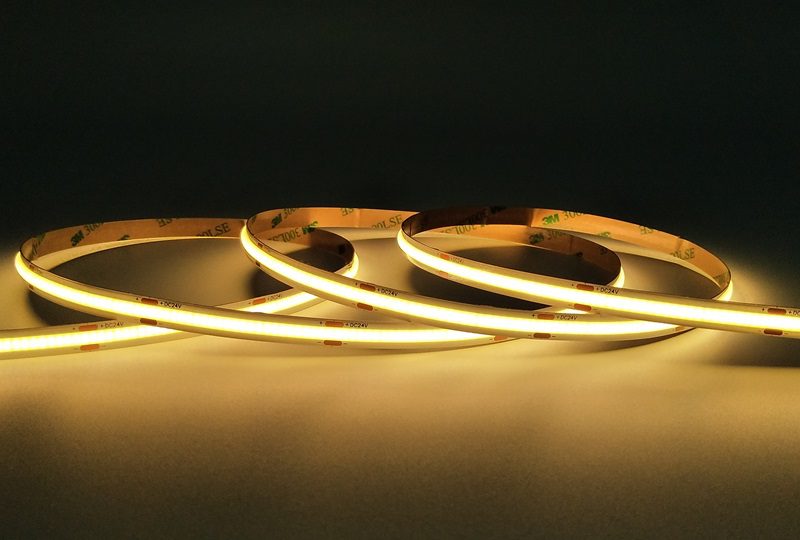
Lighting technology has changed dramatically over the past few years, and COB LED strip lights have become one of the most talked-about options in both residential and commercial lighting. If you are new to linear lighting, you may have seen the term “COB” and wondered whether it is better than a standard LED strip, how it works, and whether it is worth the extra cost.
This guide is designed for beginners. It explains what COB LED strip lights are, how they differ from traditional SMD LED strips, where they work best, and what to look for when buying one in 2026.
What Is a COB LED Strip?
COB stands for Chip on Board. A COB LED strip is a type of LED strip light in which many tiny LED chips are mounted closely together on the circuit board, then covered with a phosphor layer to create a smooth and continuous line of light.
Unlike traditional LED strip lights, where you can often see separate light points or “dots,” COB LED strips are designed to look dot-free or nearly dot-free. This makes them especially attractive in applications where the strip itself may be visible or reflected in glass, polished stone, mirrors, or glossy surfaces.
How Does COB LED Technology Work?
The main difference between COB and traditional LED strip technology is the way the light source is arranged.
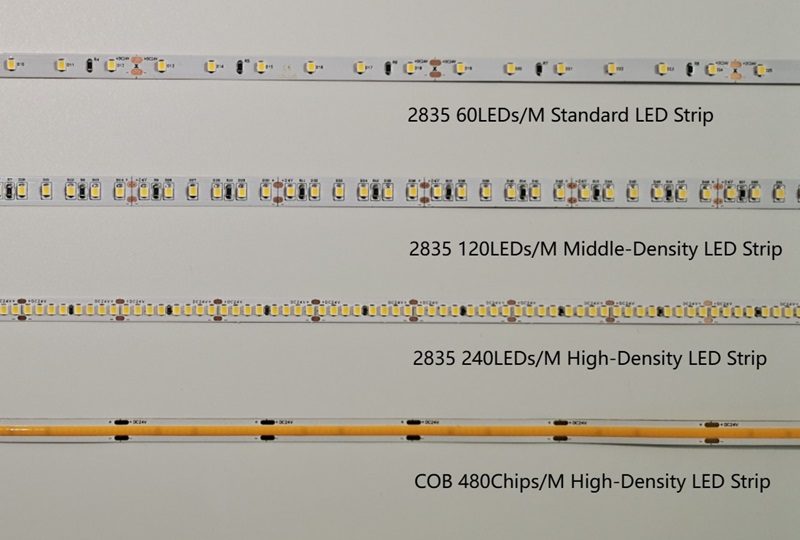
In a standard SMD strip, individual LED packages are mounted on the PCB with space between them. When the strip is on, those individual points can often be seen, especially if there is no diffuser.
In a COB strip, the LED chips are packed much more tightly together. A coating over the chips blends the output into one continuous beam. This is why COB strips are often chosen for projects that need a soft, seamless appearance.
For beginners, the most important thing to remember is this:
COB is still LED technology, but it is a more integrated and visually refined form of LED strip lighting.
Types of COB LED Strips You Can Buy
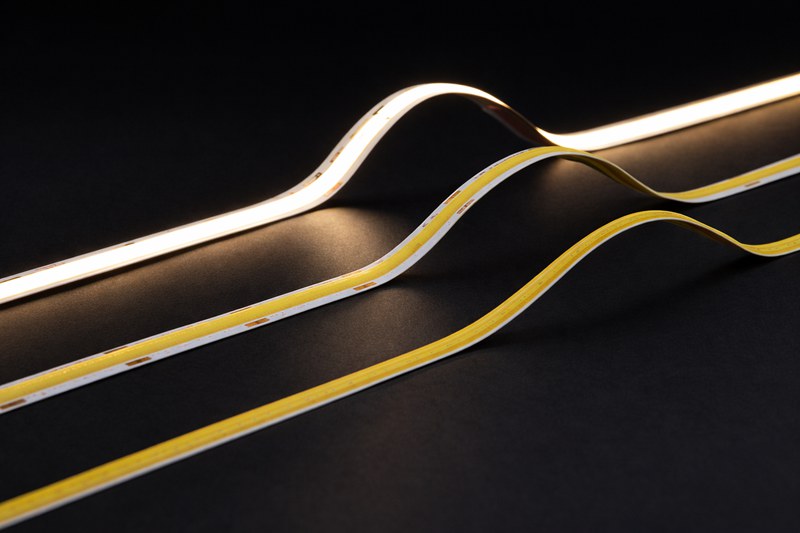
COB LED strips are available in several different versions, each designed for different lighting needs. Some are made for basic white lighting, while others are better for adjustable color temperature, decorative color effects, or outdoor use. Understanding the main types can help beginners choose the right product more easily.

This is the most common type of COB strip. It is available in warm white, neutral white, cool white, and some specialty colors, and is widely used for general lighting and clean architectural effects.
2. Tunable White COB LED Strip
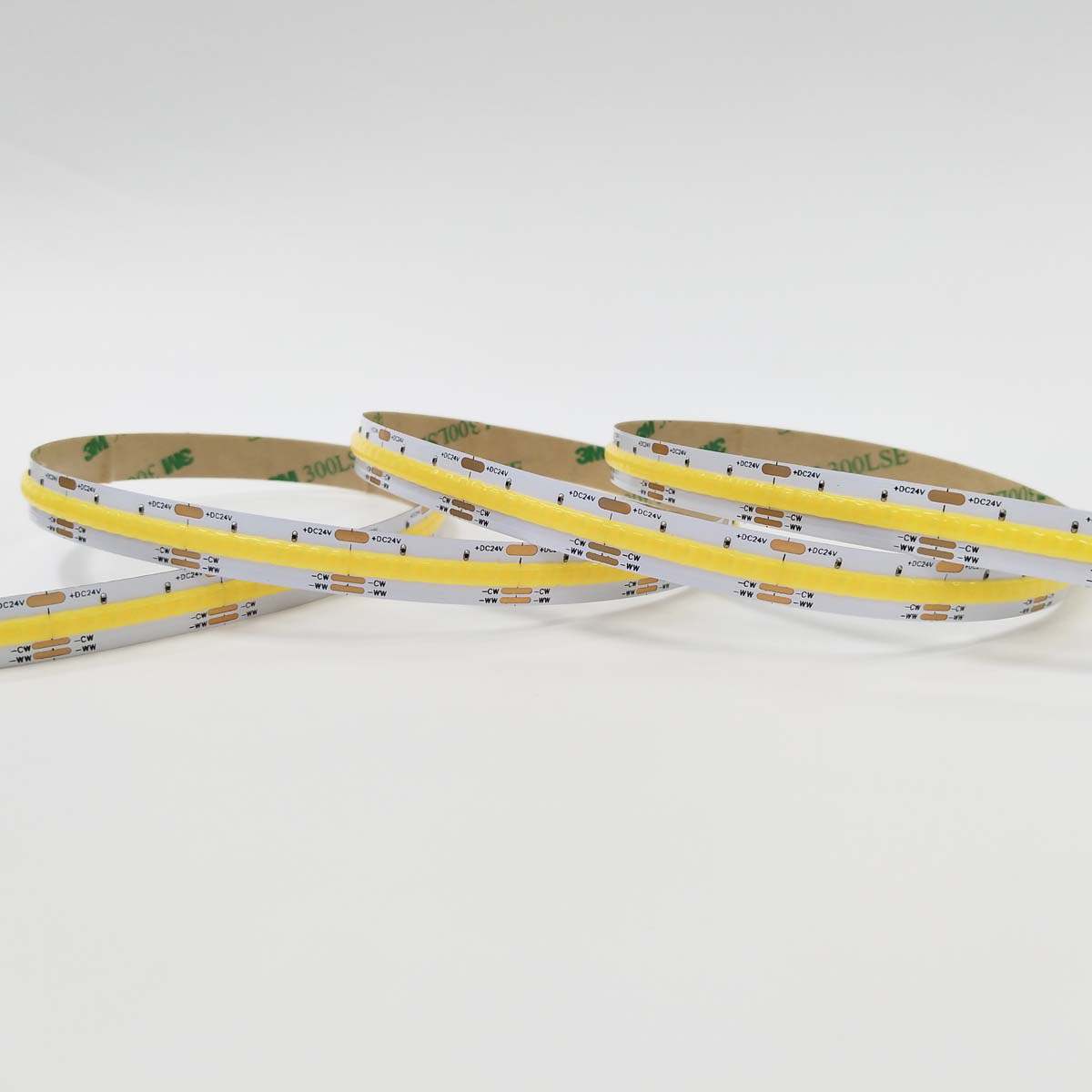
Tunable white COB strips allow you to adjust the color temperature from warm white to cool white. They are a good choice for spaces that need different lighting moods or working conditions throughout the day.

RGB COB strips add color-changing capability, making them suitable for decorative lighting, entertainment spaces, and projects that require more dynamic visual effects.
4. RGBW or RGB+CCT COB LED Strip

These versions combine RGB color with white light output, offering greater flexibility than standard RGB strips. They are useful in spaces that need both decorative color effects and practical daily lighting.
5. Pixel Addressable COB LED Strip

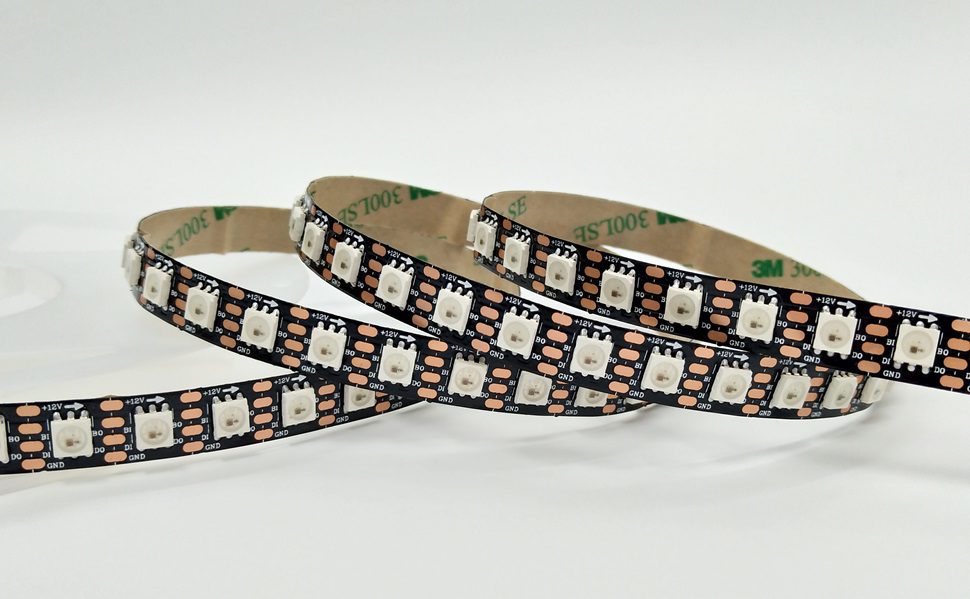
Pixel addressable COB LED strips allow individual sections of the strip to be controlled separately. They are suitable for dynamic lighting effects, digital chasing effects, and more advanced decorative or entertainment lighting projects.
6. Special COB LED Strip
Some COB LED strips are developed for more specialized applications. Common examples include:
6.1 Free Cut COB LED Strip – can be cut at almost any position for more flexible installation

6.2 Ultra Thin COB LED Strip – designed for very narrow spaces or slim lighting structures

6.3 Side Emitting COB LED Strip – emits light from the side and is useful for edge lighting and special profiles
6.4 Ultra Length COB LED Strip – made for extra-long runs and large lighting projects
Main Benefits of COB LED Strip Lights

1. Seamless, Dot-Free Lighting
The biggest advantage of COB LED strips is their smooth and continuous light output. Unlike many standard LED strips, they do not show obvious light dots, which makes them ideal for visible linear lighting.
2. Better Light Uniformity
Because the chips are packed closely together, COB strips provide more even illumination across the full length of the strip. This helps create a cleaner and more professional lighting effect.
3. Excellent for Shallow Profiles
With their wide beam angle and dot-free output, COB LED strips perform especially well in shallow aluminum profiles where SMD strips may still show visible hotspots.
4. High CRI Options
Many COB LED strips are available in CRI 90+ versions, making them a good choice for applications where accurate color rendering matters, such as retail displays, kitchens, and workspaces.
5. Clean and Modern Appearance
COB strips are typically slim and visually refined, which makes them well suited for minimalist interiors, display lighting, and architectural accent lighting.
Potential Drawbacks of COB LED Strips
COB LED strips offer excellent light uniformity and a clean visual effect, but they also come with a few technical limitations that should be considered before selection.
1. Batch-to-Batch Color Consistency Can Be More Difficult
Because COB LED strips generally do not go through the same detailed LED binning process used in many SMD products, maintaining perfect color consistency across different production batches can be more challenging. In practical applications, this means that strips from different batches may show slight differences in color temperature or overall light tone.
2. Customization Is Less Flexible
Compared with conventional SMD LED strips, COB strips are usually less flexible when it comes to customization. Adjustments such as wattage, color temperature, PCB width, and other structural specifications often require a relatively high minimum order quantity. In many cases, custom COB production starts at around 500 meters or more, which makes small-batch customization less practical.
3. High Luminous Efficacy Is Harder to Achieve
COB LED strips are designed primarily for smooth, dot-free illumination rather than maximum luminous efficacy. As a result, they are generally less efficient than high-efficacy SMD LED strips. In most cases, the upper limit for COB strip efficacy is around 140 lm/W, which is lower than some premium SMD solutions designed for high-output applications.
4. Voltage Drop Can Be More Noticeable
Most COB LED strips are designed with multiple chips connected in series, and many common versions use an 8-chip series structure. Because of this design, voltage drop over longer runs can become more obvious. Since COB produces a continuous line of light, any brightness reduction along the strip is often easier to notice visually than on some conventional SMD strips.
Applications of COB LED Strips

COB LED strips are commonly used in projects that require smooth, uniform, and dot-free lighting. Their seamless light output makes them especially suitable for visible linear lighting and applications where lighting appearance matters.
Under-cabinet lighting
Cove lighting
Display lighting
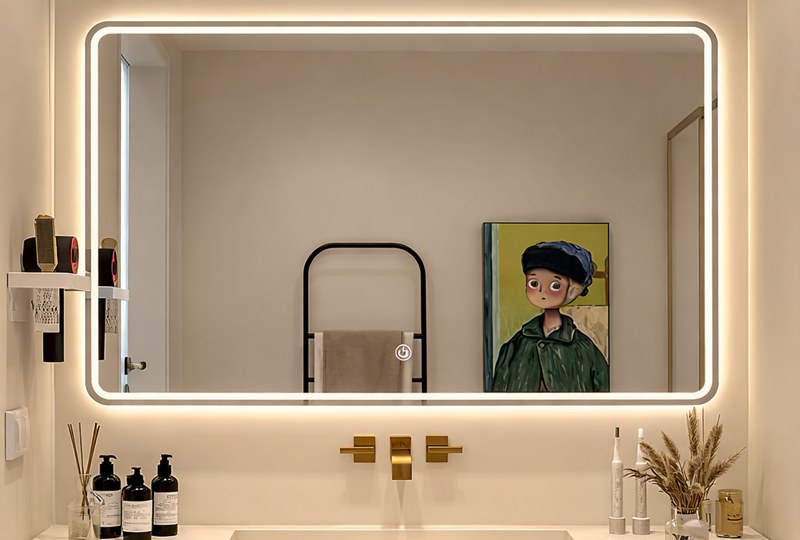
Mirror lighting
Shelf lighting
Architectural accent lighting
Furniture lighting
Commercial lighting
Hospitality lighting
Reflective surface lighting
COB vs SMD LED Strip: What’s the Difference?
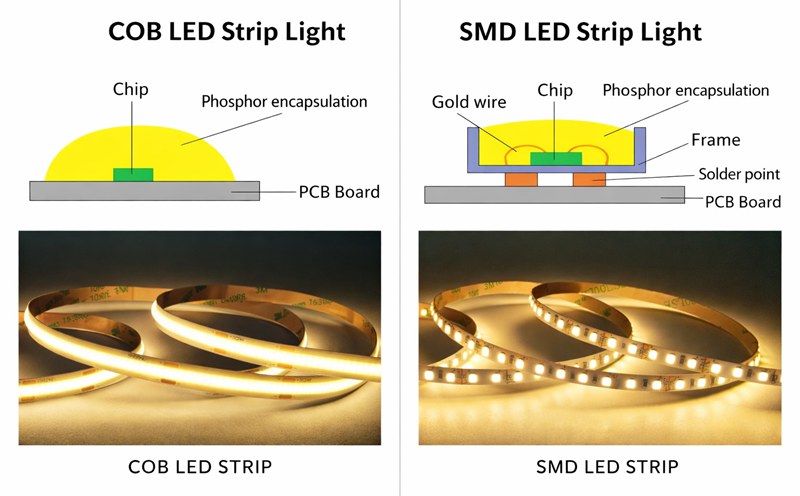
If you are comparing COB and SMD LED strips, the real difference is not just the packaging method. It also affects light uniformity, beam angle, profile compatibility, color consistency, luminous efficacy, and performance over long runs. Instead of asking which one is absolutely better, it is more useful to ask which one is better for your specific application.
| Comparison Point | COB LED Strip | SMD LED Strip |
| Light Appearance | Smooth, dot-free light. | Visible light points are common. |
| Beam Angle | Wider beam angle, about 180°. | Narrower beam angle, about 120°. |
| Performance in Shallow Profiles | Better for shallow profiles. | Hotspots are easier to see. |
| Luminous Efficacy | Usually lower than high-efficacy SMD. | Usually better in high-efficacy applications. |
| Color Consistency Between Batches | Harder to keep fully consistent. | Easier to control across batches. |
| Voltage Drop in Long Runs | More visually noticeable. | Still present, but often less obvious. |
How to Choose the Right COB LED Strip
If you are buying your first COB LED strip, focus on these practical factors.
1. Choose the Right Voltage
The most common options are 12V and 24V.
12V is common for shorter runs and smaller projects
24V is usually better for longer runs because it helps reduce voltage drop
For most home and architectural projects, 24V is often the more beginner-friendly choice.
2. Check CRI
For better color quality, choose a strip with CRI 90+ when possible. This matters a lot in kitchens, displays, retail, beauty areas, and workspaces.
3. Consider Color Temperature
Common white options include:
2700K–3000K for warm, cozy lighting
4000K for balanced neutral white
6000K–6500K for cool white task lighting
Choose the CCT based on the mood and purpose of the space.
4. Look at Chip Density and Uniformity
Higher chip density usually helps produce a more continuous and refined line of light. Beginners should also look for consistency in brightness and color along the full strip.
5. Check the IP Rating
If the strip will be used in wet or dusty environments, choose the right protection level.
IP20: indoor, dry locations
IP65: splash-resistant, suitable for some damp areas
IP67/IP68: stronger water resistance for more demanding environments
6. Match the Power Supply Correctly
Always choose a compatible DC power supply with enough wattage. Add extra capacity rather than running it at the absolute limit.
7. Consider Dimming and Control
If you want brightness control or color control, make sure the strip is compatible with the controller, dimmer, and power system you plan to use.
8. Check PCB and Build Quality
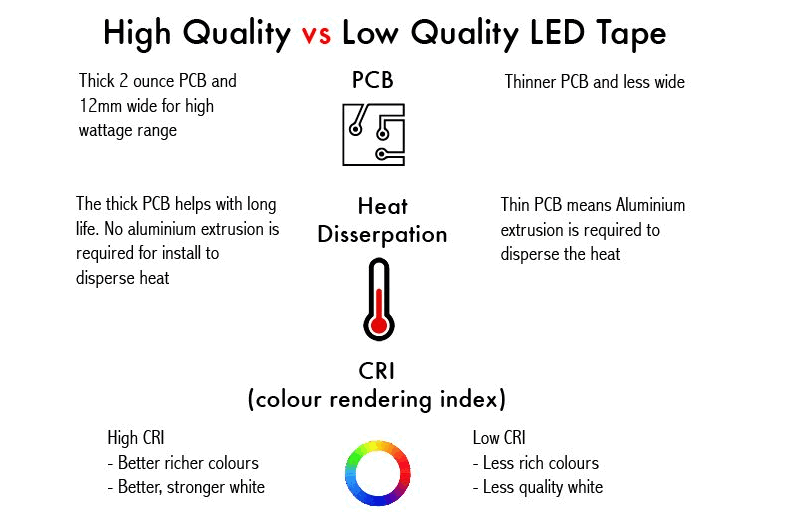
Higher-quality COB strips often use better PCB materials, better phosphor coating, stronger adhesive, and more stable manufacturing standards. This affects heat management, lifespan, and overall performance.
How to Cut, Connect, and Install COB LED Strips
COB strips are beginner-friendly, but proper installation still matters.
Step 1: Plan the Layout
Measure the installation area first. Decide where the strip will start, where power will connect, and whether corners or bends are involved.
Step 2: Cut Only at Marked Points
Most COB strips can be cut, but only at the designated cutting marks. Cutting elsewhere may damage the strip.
Step 3: Use the Correct Connector or Soldering Method
Depending on the strip type, you may connect segments with solderless connectors or by soldering.
Step 4: Clean the Mounting Surface
For the adhesive backing to work well, the surface should be clean, dry, and smooth.
Step 5: Consider an Aluminum Channel
An aluminum channel is not always required, but it is often recommended. It can:
5.1 Improve heat dissipation
5.2 Protect the strip
5.3 Create a cleaner installation
5.4 Enhance the final lighting effect
Step 6: Test Before Final Mounting
Before finishing the installation, power the strip on and confirm that brightness, polarity, color, and connections are all correct.
Why Choose Hanron COB LED Strip Light?
When choosing a COB LED strip, product quality is just as important as lighting performance. Hanron COB LED Strip Light is trusted by many customers because it combines smooth, uniform illumination with reliable quality and stable manufacturing standards. Hanron products comply with multiple international certifications, including ETL, CE, RoHS, LVD, and UKCA, which helps give customers greater confidence in safety, compliance, and market acceptance.
Hanron is also a professional LED strip light manufacturer with 16 years of industry experience. Its COB LED strip lights go through reliability tests such as thermal shock cycles test and twisting tests to help ensure stable performance and durability. Backed by a complete quality management system covering raw materials, production, testing, and final inspection, Hanron is able to provide more consistent product quality and dependable long-term supply for customers and projects.
Final Thoughts
COB LED strip lights have become one of the most appealing linear lighting options for beginners and professionals alike. Their biggest advantage is not just brightness, but how the light looks—smooth, continuous, clean, and much more refined than many traditional strip lights.
If you are planning a lighting project in 2026 and want a modern, premium result, COB LED strips are absolutely worth considering. They are especially useful for visible installations, reflective surfaces, display lighting, under-cabinet projects, and architectural details where standard dotted strips may look too harsh or outdated.
For beginners, the key is simple: focus on voltage, CRI, color temperature, waterproof rating, power supply compatibility, and installation method. Once those basics are right, a good COB LED strip can transform a space far more effectively than many people expect.
COB vs SMD LED Strips: Which One Is Better for Your LED Mirror?
Backlit Marble Using LED Light Sheets: Brightness, Thickness, and Cavity Depth Explained
Related Article

Need an Instant Quote For Your Upcoming Projects?
Send us the details and we will get back to you within 12 hours.