
How to choose a suitable LED Strip Light in 2026?
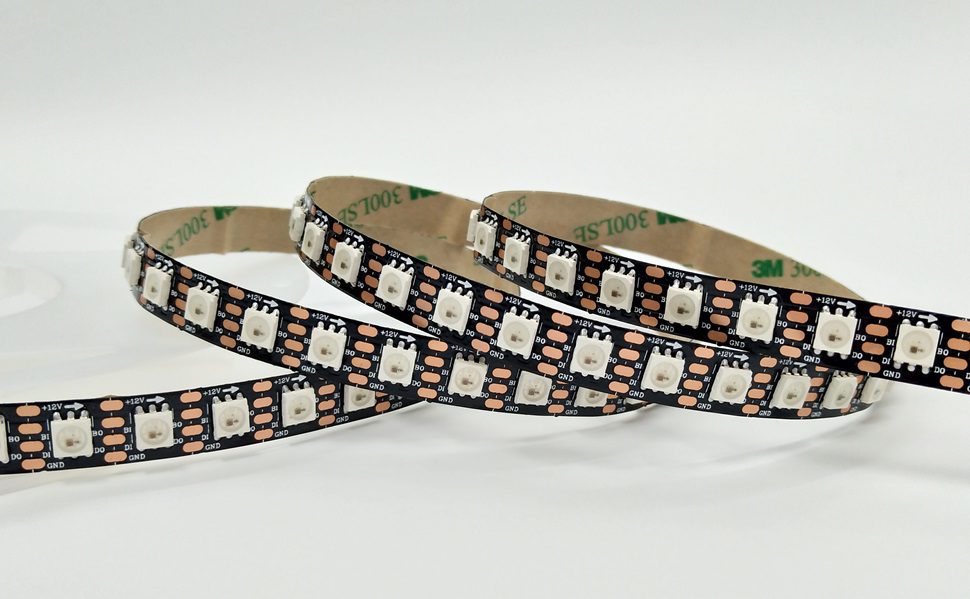
LED strip lights have become one of the most common complementary products in modern linear lighting projects. They are used in homes, hotels, shopping malls, offices, entertainment venues, display cabinets, and outdoor architectural lighting. Because there are so many different options on the market—and our company alone offers more than 2,000 models—many customers, especially general buyers or engineers new to the LED industry, are not sure which type of strip is right for their project.
In this article, we will walk through the most important parameters of LED strip lights and explain how to choose the right one based on your actual application.
Let’s get straight to the point.
How to Choose the Type of LED Strip
Generally speaking, LED strip lights can be divided into two major categories: non-addressable LED strips and addressable pixel LED strips.
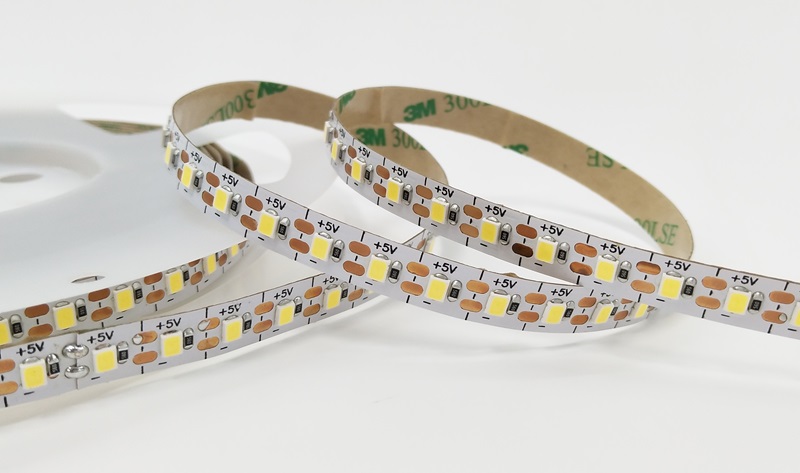
Non-addressable LED strips are the most common choice for general lighting. In this type of strip, all LEDs work together in the same color or lighting state. Typical options include single-color strips, dual-white strips, COB strips, RGB strips, RGBW strips, and RGB+CCT strips.
Each type has its own features and suitable applications.
| Type | Description | Typical Applications |
| Single-color LED Strip | LED strip with one fixed color. Common SMD versions include 2835, 5050, and 2216. It can be dimmed with a controller. | Cabinet lighting, corridor lighting, cove lighting, recessed lighting, signage, outdoor lighting |
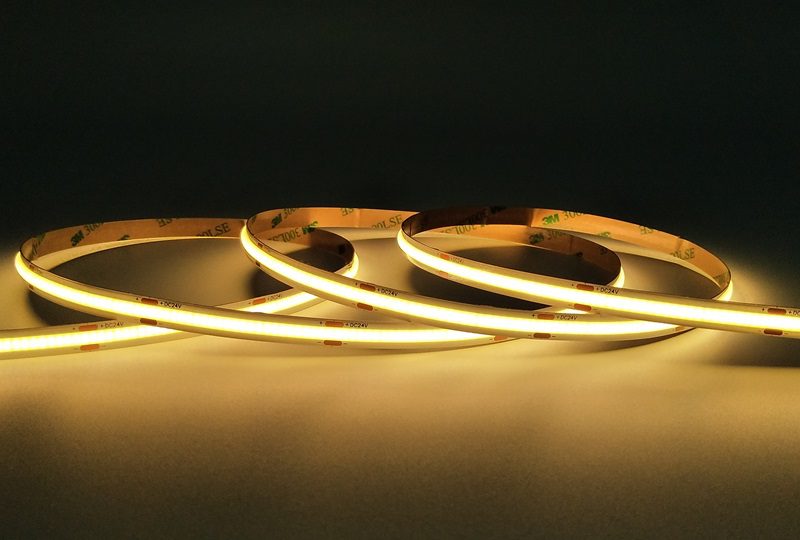
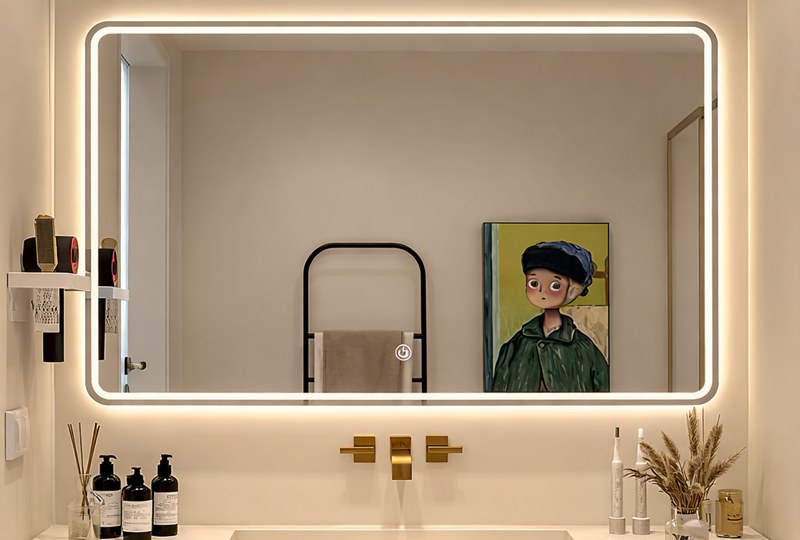
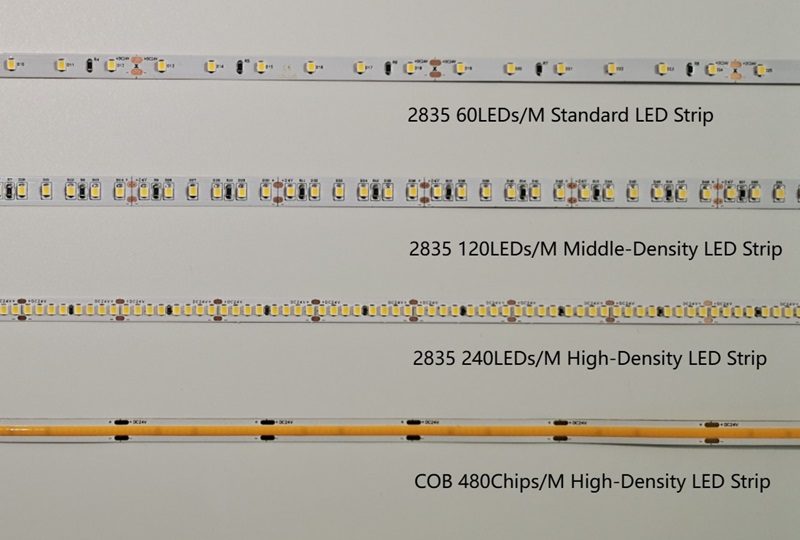
| COB LED Strip | COB LED strip uses a high-density chip arrangement to create a smooth, continuous, and nearly dot-free lighting effect. Compared with traditional SMD strips, it provides softer and more uniform light. | Under-cabinet lighting, shelf lighting, hotel lighting, mirror lighting, display lighting, aluminum profile lighting, and other visible linear lighting applications |
| Dual-white LED Strip | LED strip with two color temperatures, usually warm white and cool white, adjustable by controller. | Residential lighting, commercial lighting, hospitality projects, and spaces that require tunable white light |
| RGB LED Strip | Uses red, green, and blue LEDs to create multiple colors. Common types include 5050 RGB and COB RGB. | Decorative lighting, bars, KTV, gaming rooms, cinemas, and entertainment projects |
| RGBW LED Strip | Adds a separate white channel to RGB, providing both colorful effects and practical white light. | More advanced decorative and architectural lighting projects |
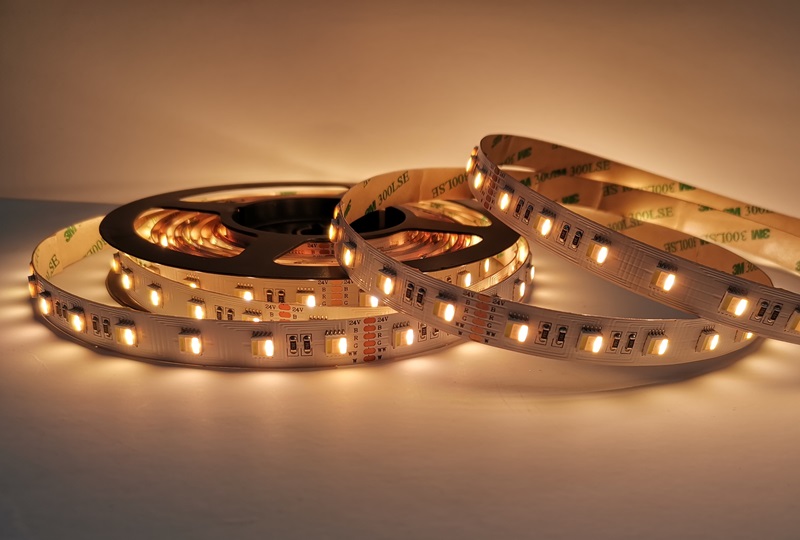
| RGB+CCT LED Strip | Combines RGB, warm white, and cool white LEDs, allowing both color changing and adjustable white color temperature. | High-end residential, commercial, and hospitality lighting |
2. Addressable Pixel LED Strips
Addressable pixel LED strips are different from standard LED strips. In these products, each group of LEDs is controlled by an IC, so different sections of the strip can show different colors at the same time. This allows dynamic effects such as chasing, flowing, running, gradients, segmented color control, and programmable animation.
At present, the two most common control systems for pixel LED strips are SPI and DMX.
2.1 SPI LED Strips
SPI stands for Serial Peripheral Interface. It is widely used in pixel LED strips and is common in many decorative and programmable lighting projects.
SPI strips can be divided into two main types:
2.1.1 External SPI LED Strips
These strips use external ICs to control lighting effects. Popular models include WS2811 LED Strip, WS2814 LED Strip, WS2818 LED Strip, and UCS2904B LED Strip.
2.1.2 Internal SPI LED Strips
These strips have built-in ICs, making them more compact and easier to integrate. Popular models include WS2812 LED Strip, WS2813 LED Strip, WS2815 LED Strip, SK6812 RGBW LED Strip, and SK9822 LED Strip.
In general, SPI LED strips are more affordable and are widely used in consumer products, decorative lighting, signage, gaming setups, and budget-friendly programmable projects.
2.2 DMX LED Strips
DMX LED strips use external DMX ICs and are designed for more stable signal transmission and longer control distance. They are widely used in professional lighting environments such as stage lighting, events, building façades, landscape projects, and other large installations.
Compared with SPI, DMX usually offers better stability and stronger performance in complex control systems, but the cost is also higher.
Popular options include White DMX LED Strip, Dual White DMX LED Strip, and Color DMX LED Strip.
SPI vs. DMX LED Strips
Comparison of SPI and DMX LED Strips
| Feature | SPI LED Strips | DMX LED Strips |
| Signal Type | SPI | DMX |
| IC Type | Internal or external IC | External DMX IC |
| Signal Stability | Moderate | High |
| Transmission Distance | Shorter | Longer |
| Cost | More affordable | More expensive |
| Control | Simpler | More professional and complex |
| Typical Uses | Decorative projects, consumer products, budget-friendly installations | Stage lighting, events, façade lighting, high-end professional projects |
| Effects | Basic to mid-level dynamic effects | More advanced and stable system control |
How to Choose the Right Color Temperature
Color temperature is one of the most important factors in lighting design because it directly affects the mood of a space. It is measured in Kelvin (K).
Warm color temperatures usually create a cozy, soft, and welcoming atmosphere. Cool color temperatures create a brighter, cleaner, and more energetic feeling.
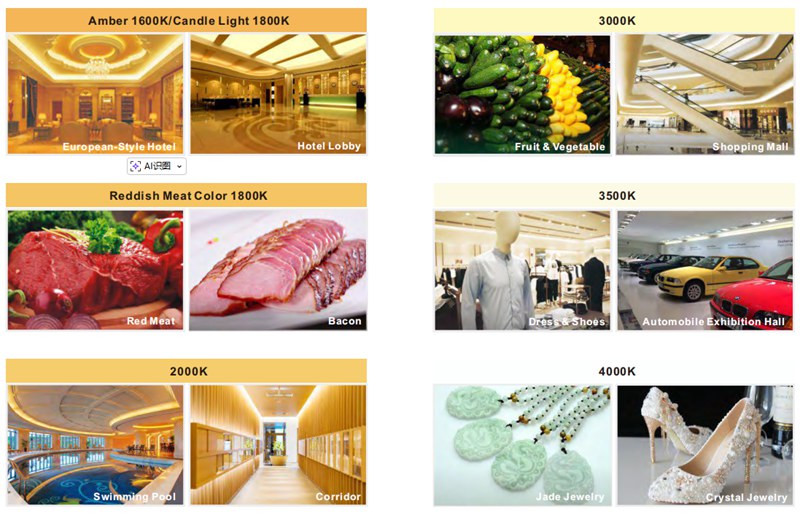
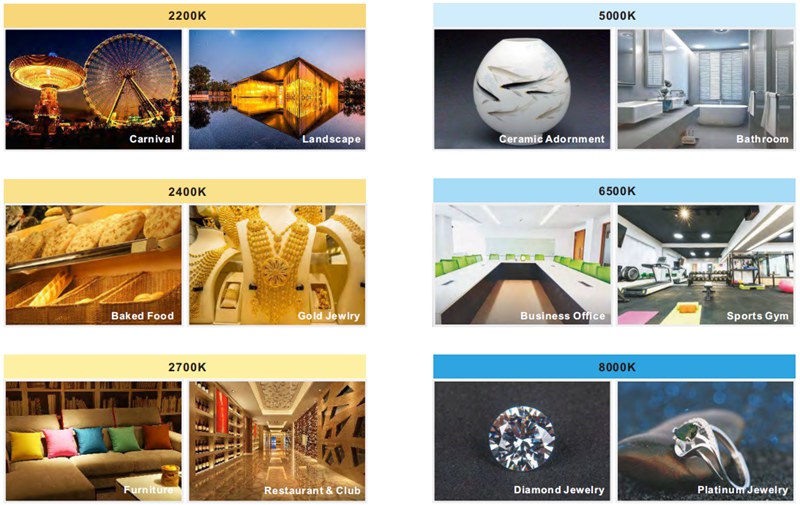
To help you choose the best color temperature for your lighting needs, refer to the following table, which outlines various color temperatures and their recommended usage scenarios:
| Color Temperature | Scenario 1 | Scenario 2 |
| Amber 1600K / Candlelight 1800K | European-style hotels | Hotel lobbies |
| Flesh Red 1800K | Red meat | Bacon |
| 2000K | Swimming pools | Corridors |
| 2200K | Carnivals | Landscapes |
| 2400K | Baked goods | Gold jewelry |
| 2700K | Furniture | Restaurants & clubs |
| 3000K | Fruits & vegetables | Shopping malls |
| 3500K | Clothing & footwear | Auto showrooms |
| 4000K | Emerald jewelry | Crystal jewelry |
| 5000K | Ceramic decor | Bathrooms |
| 6500K | Business offices | Sports gyms |
| 8000K | Diamond jewelry | Platinum jewelry |
How to Choose the Waterproof Rating?
LED strips are available in different waterproof structures. The correct waterproof level depends on the installation environment, whether it is indoor, semi-outdoor, outdoor, or even underwater.
The waterproof level is shown by the IP rating.
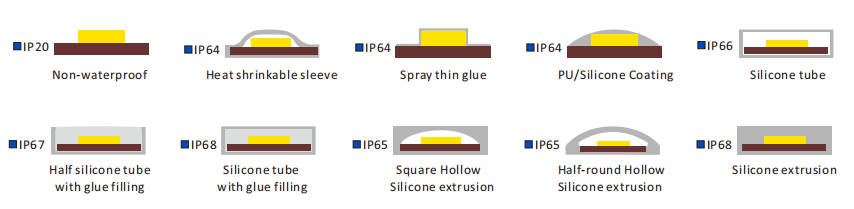
Different waterproof levels are available based on the IP rating. Here's a breakdown of the types:
| Waterproofing Material | IP Rating | Applicable Scenario | Luminance Attenuation | Color Shift | Cable Exit Type | Mounting Method | Accessories |
| Non-waterproof | IP20 | Indoor | / | / | Standard Cable | 3M Tape | / |
| Heat Shrink Tubing | IP64 | Indoor or Semi-outdoor | 0.03 | 0.03 | Standard Cable | 3M Tape | / |
| Sprayed Silicone | IP64 | Indoor or Semi-outdoor | 0.03 | High | Standard Cable | 3M Tape | / |
| Silicone or Polyurethane Gel | IP64 | Indoor or Semi-outdoor | 0.03 | High | Standard Cable | 3M Tape | / |
| Silicone Sleeve | IP66 | Outdoor | 0.05 | 0.03 | Waterproof Cable | Clip + Screw | End Cap + Clip + Screw |
| Semi-silicone Sleeve with Filled Gel | IP67 | Outdoor | 0.05 | 0.03 | Waterproof Cable | Clip + Screw | End Cap + Clip + Screw |
| Full Silicone Sleeve with Filled Gel | IP68 | Within 2m Underwater | 0.05 | High | Waterproof Cable | Clip + Screw | End Cap + Clip + Screw |
| Square Hollow Silicone Extrusion Profile | IP65 | Outdoor | 0.05 | 0.03 | Waterproof Cable | Clip + Screw | End Cap + Clip + Screw |
| Semi-circular Hollow Silicone Extrusion Profile | IP65 | Outdoor | 0.05 | 0.03 | Waterproof Cable | Clip + Screw | End Cap + Clip + Screw |
| Solid Silicone Extrusion Profile | IP68 | Within 2m Underwater | 0.05 | High | Waterproof Cable | Clip + Screw | End Cap + Clip + Screw |
How to Choose CRI
CRI means Color Rendering Index. It shows how accurately the light reveals the real color of objects. The higher the CRI, the better the color appearance.
For LED strip lights, CRI is an important quality indicator.
Common CRI levels include:
CRI 80+
CRI 90+
CRI 95+
CRI 97+
For general office or commercial lighting, CRI 80+ is usually acceptable.
For home lighting, hospitality projects, and most mid-to-high-end applications, CRI 90+ is often recommended.
For school lighting, museums, premium retail displays, and applications where color accuracy is especially important, CRI 95+ or CRI 97+ may be the better choice.
How to Choose the Right Voltage
Choosing the right voltage for an LED strip mainly depends on the power system, installation length, cutting requirements, and application type. The most common voltage options are 5V, 12V, and 24V.
In general, 5V LED strips are often used for addressable pixel products, especially where each LED or each very small segment needs independent control. This is common in products such as WS2812 or other pixel LED strips used for dynamic effects.
12V LED strips are widely used in smaller installations and projects where shorter cutting lengths are important. Because the cutting interval is usually shorter than that of 24V strips, 12V can be a better choice when the project requires more flexible installation or more precise length adjustment.
24V LED strips are usually the better option for longer runs. They help reduce voltage drop and provide more stable brightness over distance. For most architectural, commercial, and general indoor lighting projects, 24V is often the preferred choice because it offers better overall system stability.
However, the final voltage choice should also match the available power supply, controller compatibility, and project requirements. In simple terms, if the project is short and needs finer cutting resolution, 12V may be more suitable. If the project is longer and needs better stability, 24V is usually the better choice.
How to Choose Power and Brightness
In most cases, higher power means higher brightness. So if your project needs a brighter strip, you usually need a higher-power model. However, brightness should not be chosen blindly. It should be matched to the actual application.
Here is a useful reference for recommended luminous flux:
| Application Area | Required Luminous Flux per Foot (lm) |
| Accent Lighting and Mood Lighting | 150 to 350 |
| Under Cabinet Lighting | 175 to 525 |
| Close-Source Task Lighting | 280 to 450 |
| Task Lighting at a Distance from Source | 500 to 1000 |
| Indirect Lighting | 375 to 575 |
| Signage Lighting | 500 to 950 |
Of course, brightness is not the only issue. You should also think about installation height, aluminum profile depth, diffuser cover, and whether the strip is used as primary lighting or decorative lighting.
If your project has high efficiency requirements, you can also choose high-efficacy LED strips. That is a separate product topic, but it is absolutely worth considering for projects focused on energy saving.
A Practical Example: How to Choose the Right LED Strip Step by Step
Now let’s make this more practical.
Imagine a customer has a hotel corridor lighting project. The LED strip will be installed inside an aluminum profile in a recessed ceiling detail. The customer wants the lighting effect to look soft, continuous, comfortable, and a little high-end.
So how do we choose the right strip?
Step 1: Confirm the lighting purpose
This is not a colorful decorative project. It is architectural ambient lighting. So the customer does not need SPI or DMX pixel strips. A white non-addressable LED strip is the right direction.
Step 2: Decide between SMD and COB
Because the strip will be visible through an aluminum profile, dot-free lighting is important. In this case, COB LED strip is a better choice than standard SMD strip, because it produces a smoother and more continuous line of light.
Step 3: Choose the color temperature
For a hotel corridor, the atmosphere should feel warm, relaxing, and premium. So 3000K is a very suitable option. If the design is even warmer and more luxurious, 2700K can also work well.
Step 4: Choose the CRI
Hotels usually care about visual comfort and lighting quality. So CRI 90+ is recommended. It gives better color rendering and a more refined feeling than CRI 80.
Step 5: Choose the voltage
If the installation run is not very short, 24V is usually a better choice than 12V, because it helps reduce voltage drop and is more suitable for architectural projects.
Step 6: Choose the waterproof level
This is an indoor dry corridor, so IP20 is normally enough. There is no need to choose a waterproof structure unless the project environment is humid or dusty.
Step 7: Choose the brightness
The project needs comfortable ambient lighting, not harsh direct brightness. A medium-power COB strip is usually enough. The final choice can be adjusted according to profile depth, diffuser cover, and lighting design target.
Step 8: Confirm the accessories
The customer will also need a matching aluminum profile, diffuser cover, LED driver, and if dimming is needed, a suitable dimmer or controller.
Final Recommendation for This Project
A practical recommendation could be:
24V COB LED Strip + 3000K + CRI 90+ + IP20 + aluminum profile + dimmable driver
This combination is very suitable for hotel corridor lighting because it creates a soft, uniform, and professional linear lighting effect.
That is really the key point: choosing LED strip lights should not start from the model number. It should start from the project requirement.
How to Customize LED Strips?
Many customers do not need only standard models. For engineering projects, OEM products, or new product development, LED strips can often be customized.
Common customization options include the following:
| Customization Item | Options / Description |
| LED chip type / brand | Cree, Osram, and other brands, or specified chip type based on project needs |
| CRI | Ra 80, 90, 95, 97, etc. |
| Color temperature / colors | 1800K to 6500K, special colors, single color or mixed color |
| LED quantity and arrangement | Single-row or multi-row design, customized density |
| Waterproof rating | IP20, IP54, IP66, IP67, IP68, etc. |
| Voltage | 5V, 12V, 24V, or custom voltage range |
| Power | Adjustable according to application requirements |
| Strip length | Custom segment length or full roll |
| Wire length | Custom input wire length |
| PCB color | White, black, yellow, or custom colors |
| Label / packaging | Private label, logo printing, custom packaging design |
Different customization items may have different minimum order quantities, so for detailed project requirements, it is always better to confirm with the supplier in advance.
What Accessories Are Typically Needed?
LED strip projects usually require more than just the strip itself. Common accessories include:
Aluminum profiles help with heat dissipation, installation, and a cleaner final appearance. Different shapes are available for recessed, surface-mounted, corner, or suspended applications.
These include board-to-board connectors, board-to-wire connectors, and waterproof connectors for different IP-rated products.
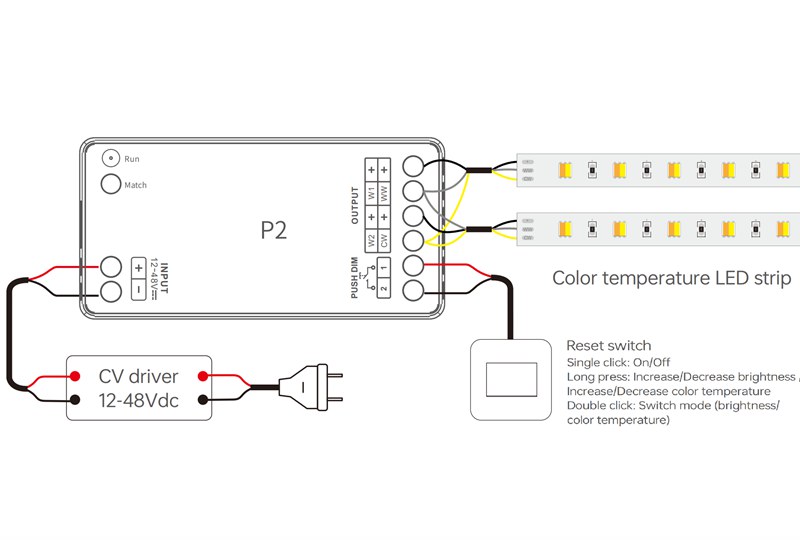
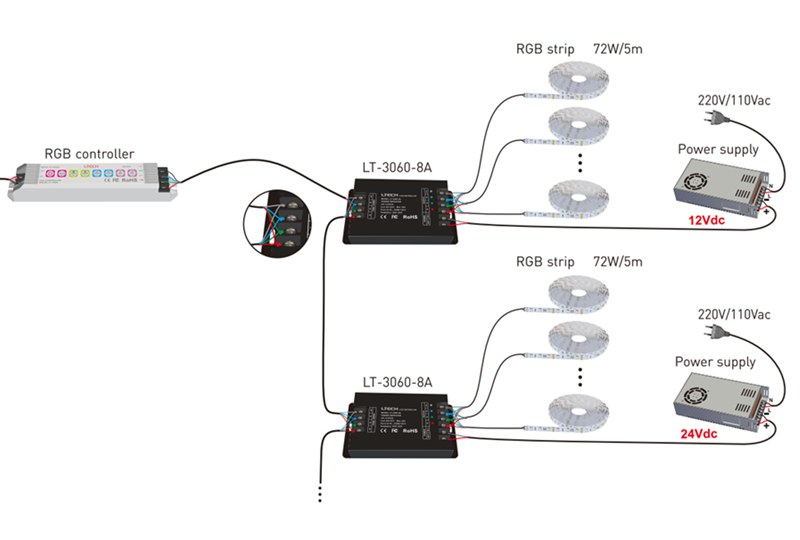
Different strip types require different control systems. Single-color strips, dual-white strips, RGB strips, RGBW strips, and pixel strips all use different controllers. If the customer is not sure which one is suitable, technical support is usually needed.
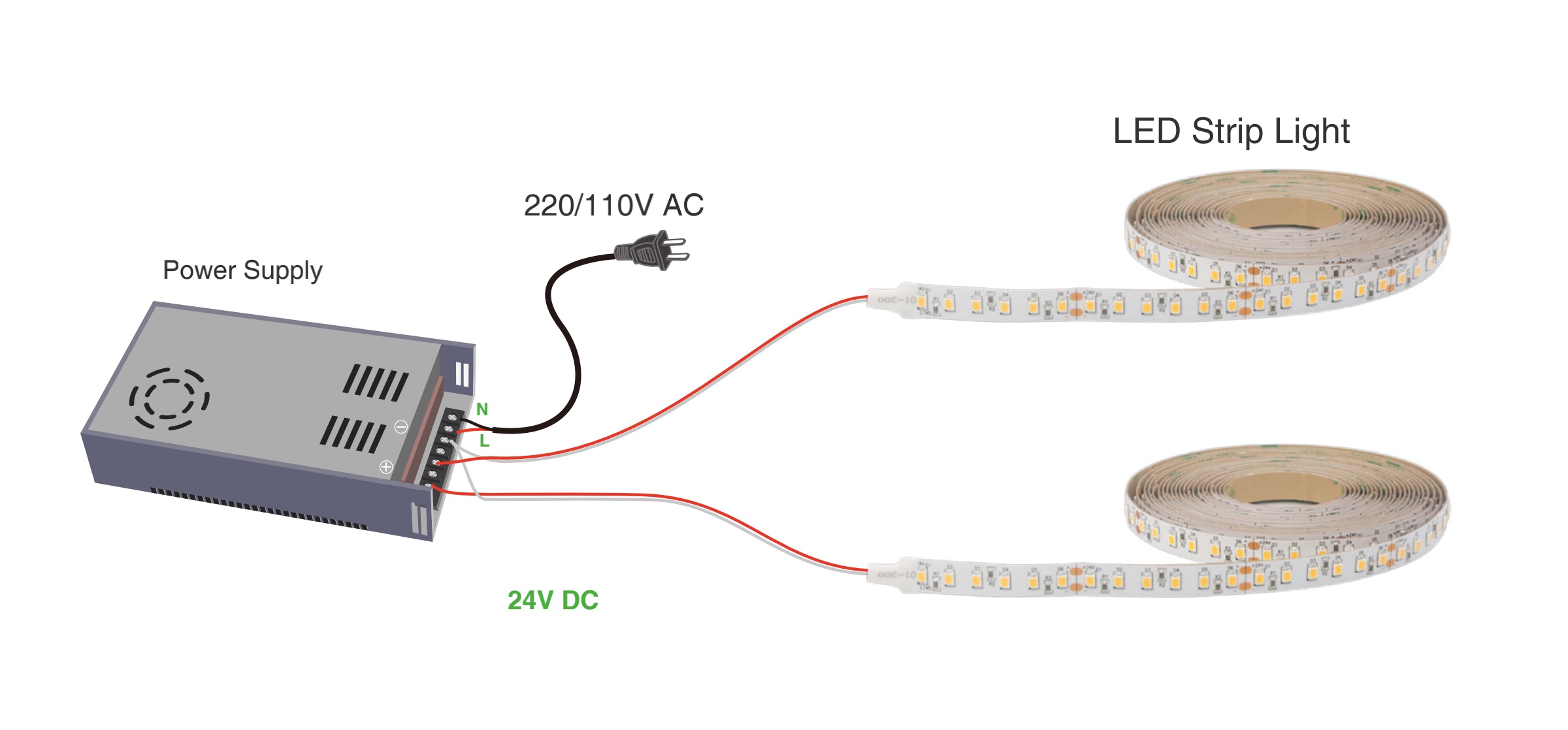
The driver must match the strip voltage and power requirement. This part is very important for system stability and long-term performance.
Conclusion
Choosing the right LED strip light is not only about selecting a model number. It is really about understanding the project requirement first. Once you know the application, the lighting effect, the environment, and the control needs, the correct product becomes much easier to find.
In most cases, you only need to focus on a few key points:
LED strip type, COB or SMD structure, color temperature, waterproof rating, CRI, voltage, brightness, and accessories.
If you are still not sure which LED strip is best for your project, feel free to contact us. Based on your installation environment, lighting purpose, and budget, we can recommend the most suitable solution for you.
COB LED Strip Passed 160hrs Thermal Shock Cycles Test
How to Design LED Strip Light in the Bathroom?
Related Article
Need an Instant Quote For Your Upcoming Projects?
Send us the details and we will get back to you within 12 hours.