
12V vs 24V COB LED Strip: How to Choose the Right Voltage
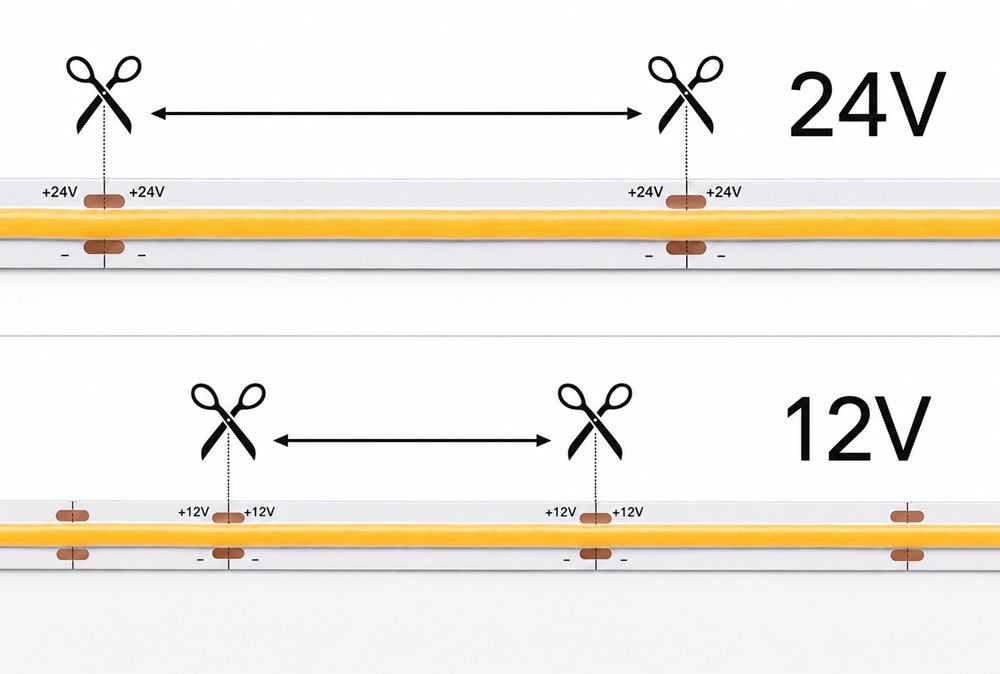
When selecting COB LED Strip for a lighting project, voltage is one of the most important specifications to consider.
Many buyers simply assume that 24V LED Strip is always better than 12V because it provides longer running distance and lower current. However, the correct choice depends on the actual application requirements, including installation length, cutting requirement, brightness level, and system design.
Both 12V and 24V COB LED Strip are widely used in professional lighting projects. Understanding their differences helps designers, installers, and purchasing teams choose the most suitable solution.
Understanding the Difference Between 12V and 24V COB LED Strip
The main difference between 12V and 24V COB LED Strip is the operating voltage of the LED circuit.
Under the same power consumption, a lower voltage system requires higher current.
For example:
A 24W LED Strip:
12V system:
24W ÷ 12V = 2A
24V system:
24W ÷ 24V = 1A
The higher current in 12V systems creates more voltage loss along the PCB circuit, especially in longer installations.
This is why 24V COB LED Strip is often preferred for commercial and architectural projects requiring longer continuous runs.
12V COB LED Strip: Advantages and Typical Applications

The main advantages include:
Shorter Cutting Length
12V systems usually have shorter cutting units, allowing more precise installation adjustment.
This is especially useful for:
- Cabinet lighting
- Furniture lighting
- Small decorative projects
When installation dimensions are irregular, shorter cutting intervals provide more flexibility.
Suitable for Compact Lighting Projects
12V COB LED Strip is commonly used where:
- Installation distance is short
- Power consumption is moderate
- Precise cutting is required
- Kitchen cabinets
- Wardrobes
- Shelves
- Furniture lighting
24V COB LED Strip: Advantages and Typical Applications

24V COB LED Strip is widely selected for professional projects because of its better performance over longer distances.
Lower Current and Reduced Voltage Drop
Compared with 12V systems, 24V COB LED Strip operates at lower current under the same power level.
This provides advantages such as:
- Less voltage drop
- More stable brightness
- Better performance for long installations
For example, in a 10-meter or longer installation, 24V COB LED Strip usually provides better brightness consistency from beginning to end.
Better for Commercial and Architectural Projects
24V COB LED Strip is commonly recommended for:
- Hotels
- Retail stores
- Commercial displays
- Architectural lighting
- Large indirect lighting projects
These applications usually require:
- Longer installation length
- Longer operating hours
- More stable lighting performance
Cutting Length: Is 24V Always Twice as Long as 12V?
A common understanding in the LED Strip industry is:
The cutting unit of 24V LED Strip is usually twice as long as 12V LED Strip.
For traditional SMD LED Strip, this is often true.
For example:
12V:
Cutting unit: 3 LEDs
24V:
Cutting unit: 6 LEDs
However, COB LED Strip technology is more flexible.
Because COB LED Strip uses different circuit designs and chip arrangements, the cutting length is not always determined only by voltage.
Some COB LED Strip products may have:
12V and 24V versions with different cutting lengths
The same cutting length for both 12V and 24V versions
Therefore, when selecting COB LED Strip, buyers should confirm the actual cutting unit specification instead of assuming that 24V is always double 12V.
This is especially important for customized COB LED Strip projects.
12V vs 24V COB LED Strip Comparison
Both 12V and 24V COB LED Strip use the same COB lighting technology, but their electrical design creates differences in installation performance.
The main differences are related to current, voltage drop, installation length, and application requirements. There is no absolute answer that one voltage is always better than the other. The right choice depends on the project size, required brightness, installation distance, and flexibility requirements.
The following table provides a quick comparison of the key differences between 12V and 24V COB LED Strip.
| Feature | 12V COB LED Strip | 24V COB LED Strip |
| Current | Higher current | Lower current |
| Voltage drop | More noticeable in long runs | Better performance for long runs |
| Cutting flexibility | Usually shorter cutting unit | Usually longer cutting unit, but depends on design |
| Installation length | Short to medium distance | Medium to long distance |
| Best for | Cabinet, furniture, decorative lighting | Commercial, architectural, large projects |
| Power efficiency | Suitable for small applications | Better for larger installations |
How to Choose Between 12V and 24V COB LED Strip?
The correct voltage depends mainly on the project requirements.
Choose 12V COB LED Strip When:
- The installation distance is short
- Frequent cutting adjustment is required
- The project is small-scale
- Space is limited
Examples:
- Cabinet lighting
- Wardrobe lighting
- Furniture lighting
Choose 24V COB LED Strip When:
- Longer installation length is required
- Stable brightness is important
- The project operates for many hours
- Voltage drop needs to be minimized
Examples:
- Commercial display lighting
- Hotels
- Architectural lighting
- Large indirect lighting
Relationship Between Voltage and Power Selection
Voltage selection is also related to COB LED Strip power.
For low-power products:
12V and 24V may both perform well
For high-power products:
24V is usually preferred because it reduces current load and improves system stability
For example:
A high brightness COB LED Strip above 10W/m installed over several meters will generally benefit from a 24V design.
Custom COB LED Strip: Voltage Can Be Designed According to Application
For professional projects, standard 12V and 24V products may not always meet every requirement.
COB LED Strip can be customized according to:
- Power consumption
- Cutting length
- PCB design
- Installation distance
- Brightness requirement
For OEM projects, choosing the correct voltage at the design stage can improve installation efficiency and overall system performance.
Conclusion
There is no universal answer to whether 12V or 24V COB LED Strip is better.
12V COB LED Strip provides flexibility and is suitable for compact lighting applications where precise cutting is important.
24V COB LED Strip provides advantages in longer installations, lower current, and better voltage stability, making it a preferred choice for commercial and architectural projects.
For professional lighting applications, voltage selection should be based on installation length, power requirement, cutting needs, and overall system design.
Choosing the right voltage from the beginning helps achieve better lighting performance, easier installation, and long-term reliability.
Complete COB LED Strip Buying Guide: How to Choose the Right COB LED Strip for Your Project
COB LED Strip Installation Guide: Aluminum Profile, Heat Dissipation and Power Supply Selection
Related Article
Need an Instant Quote For Your Upcoming Projects?
Send us the details and we will get back to you within 12 hours.