
How to Choose the Right IC for an Addressable LED Strip Project?
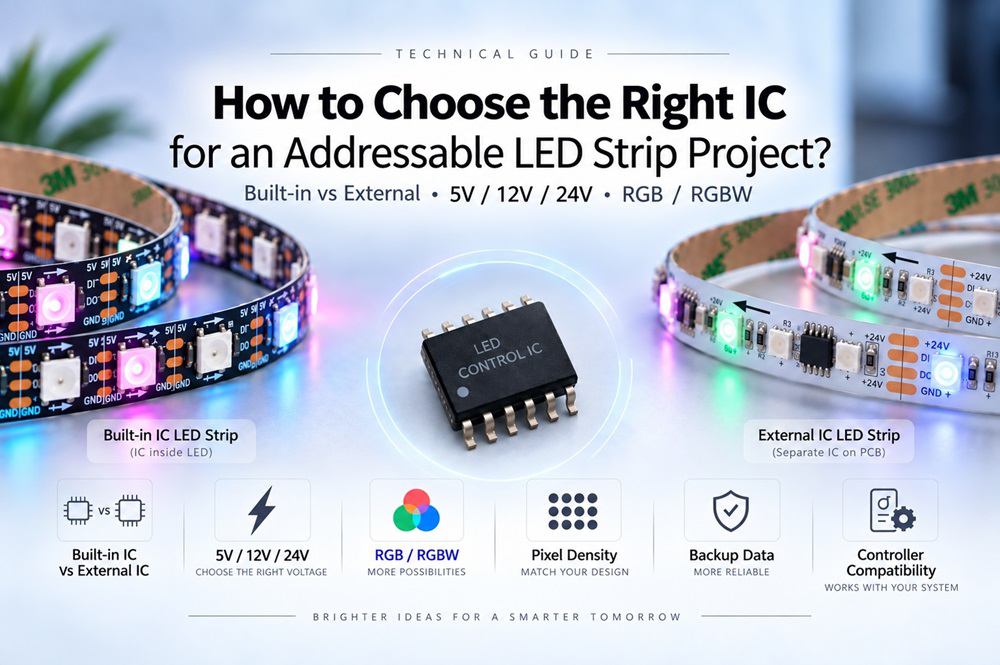
Choosing the right IC is one of the most important decisions in an addressable LED strip project.
Different ICs may look similar from the outside, but they can vary in voltage, signal type, pixel structure, RGB or RGBW support, backup data, refresh performance and cost.
For OEM and professional lighting projects, the best IC is not simply the newest or most expensive one. It should match the actual control system, installation length, pixel density and application requirements.
1. Start with the Control Requirement
Before selecting an IC, first define what kind of lighting effect is needed.
If the project only requires standard chasing, flowing and color-changing effects, a common single-data IC may already be enough.
Typical options include:
- WS2811
- WS2812B
- SK6812
- SM16703
- SM16704
- UCS1903
- UCS2904B
- TM1814
If the project requires faster control or a separate clock signal, ICs such as APA102, SK9822 or HD107S may be more suitable.
For applications where signal reliability is especially important, dual-signal or backup-data designs such as WS2813, WS2815 or WS2818 can also be considered.
The control requirement should always come before the IC model.
2. Built-In IC or External IC?
Addressable LED strips generally use either a built-in IC or an external IC.
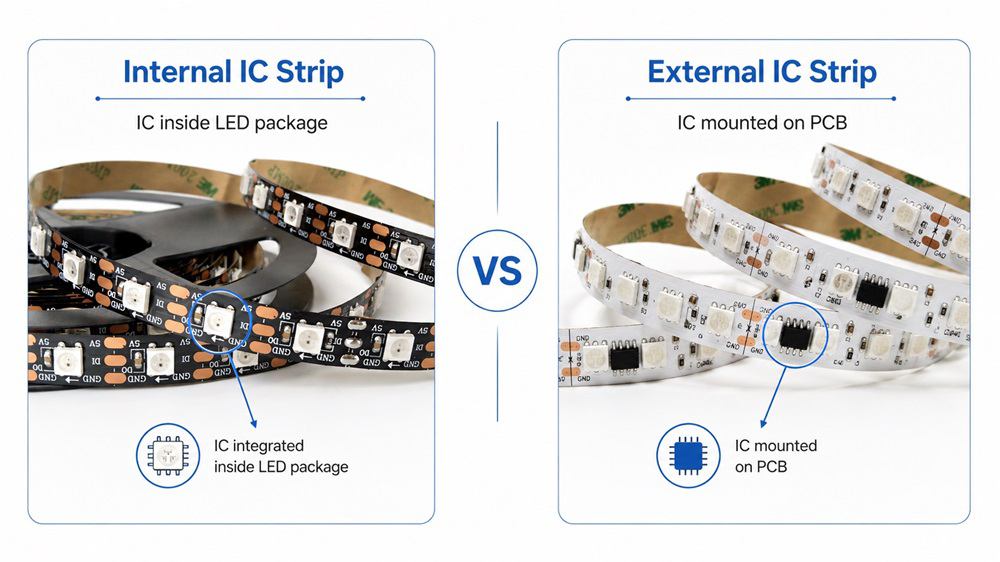
Built-In IC Addressable LED Strip
In products such as WS2812B, WS2813, WS2815 and SK6812, the control function is integrated into the LED package.
This structure is compact and is especially suitable for:
- Individually controlled pixels
- High pixel density
- Narrow PCB designs
- Decorative lighting
- Pixel displays
A common design is:
1 LED = 1 pixel
This provides high animation resolution.
External IC Addressable LED Strip
External IC strips place the driver IC separately on the PCB.
Common options include:
- WS2811
- WS2818
- SM16703
- SM16704
- UCS1903
- TM1814
- WS2814
- WS2818
External IC designs provide more flexibility in voltage and pixel grouping.
For example:
3 LEDs = 1 pixel
or
6 LEDs = 1 pixel
This can be useful when the project needs longer runs, lower pixel cost or a specific voltage configuration.
3. Check the Voltage Requirement
Voltage is closely related to IC selection.
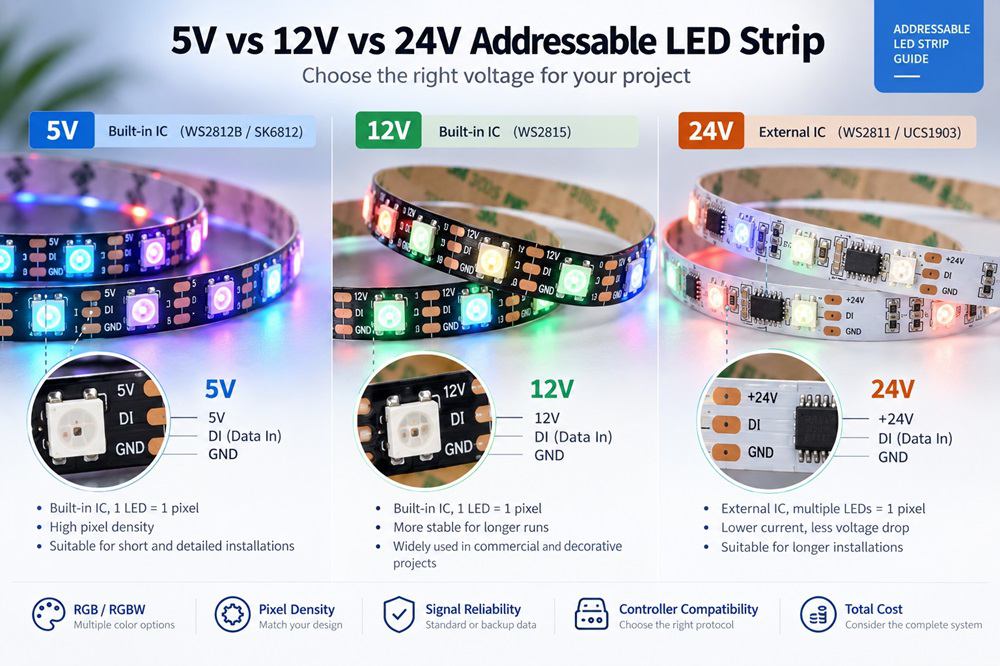
5V
5V is commonly used for individually addressable strips such as WS2812B and SK6812.
Advantages include:
High pixel resolution
One LED can equal one pixel
Suitable for short, detailed installations
The main limitation is voltage drop. Long runs usually require more careful power distribution.
12V
12V is widely used in commercial and decorative applications.
Typical IC options include WS2811 and WS2815.
12V offers a good balance between pixel control and power distribution.
24V
24V can be useful for longer installations because current is lower for the same total power.
External IC designs are often more flexible for 24V projects.
However, voltage alone does not determine the best IC. Pixel grouping, PCB design and controller compatibility should also be considered.
4. RGB or RGBW?
The required color configuration also affects IC selection.
For standard dynamic color effects, RGB IC solutions are usually sufficient.
If the project needs a dedicated white channel, an RGBW-compatible IC should be selected.
For example:
- SK6812 RGBW
- TM1814
- WS2814
- SM16704
- UCS2904B series
RGBW is especially useful when the project needs both colorful effects and practical white illumination.
For architectural or hospitality projects, this can be more suitable than using RGB mixed white.
5. Consider Signal Reliability
In some applications, a single failed pixel can affect the data transmission to pixels after it.
For this reason, backup-data IC designs may be preferred for professional projects.
ICs such as WS2813, WS2815 and WS2818 use additional signal paths depending on the design.
This can improve system reliability if one pixel or signal point fails.
These ICs can be useful for:
- Commercial installations
- Architectural lighting
- Long-term fixed installations
- Projects where maintenance is difficult
For simple decorative applications, however, a standard single-data IC may still be the most cost-effective solution.
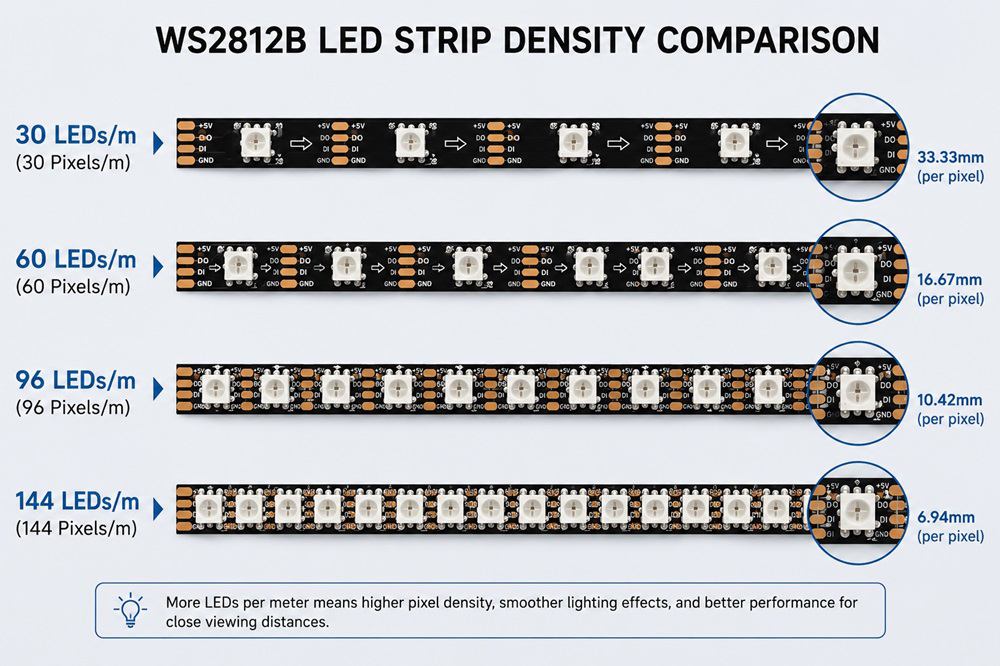
6. Pixel Density Matters
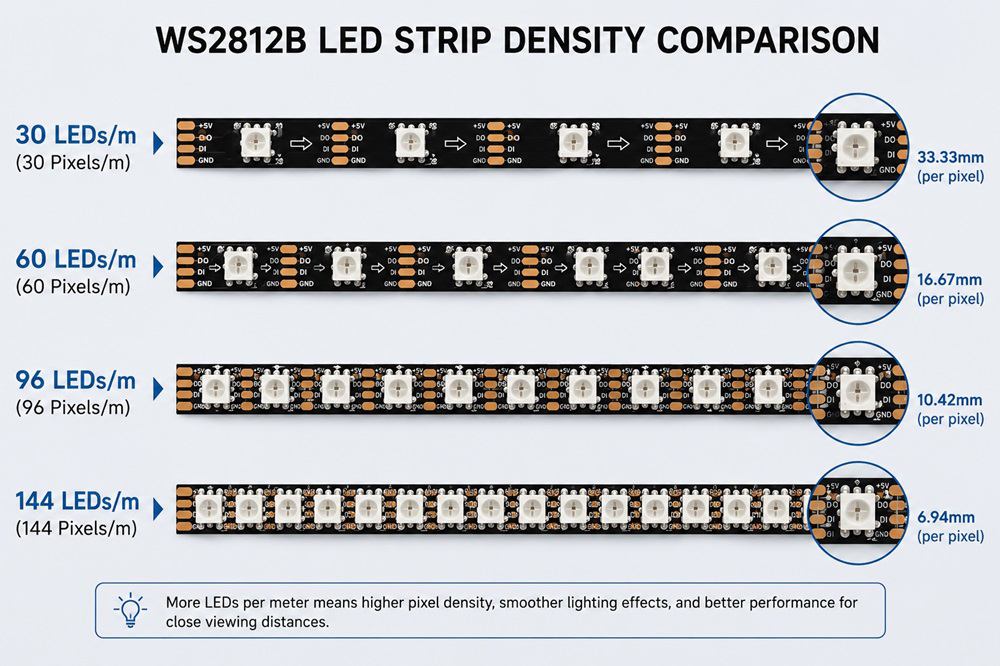
The IC must also match the required pixel density.
If every LED needs to be controlled independently, a built-in IC solution can be very practical.
For example:
60 LEDs/m = 60 pixels/m
96 LEDs/m = 96 pixels/m
144 LEDs/m = 144 pixels/m
If the project does not require every LED to be individually controlled, an external IC can control several LEDs as one pixel.
This reduces the total number of pixels and controller load.
So when choosing an IC, always consider:
LED density + Pixel density + LEDs per pixel
together.
7. Controller Compatibility Is Essential
An IC is only useful if the controller can support it.
Before finalizing the LED strip design, confirm:
- Supported IC protocol
- Data output type
- Maximum pixel quantity
- Refresh requirements
- Signal wiring
- Voltage compatibility
For example, some controllers support many common SPI ICs, while others may only support a limited list.
If the project already has an existing controller, the IC should normally be selected around that controller.
8. Cost Should Be Considered with the Complete System
A lower-cost IC does not always mean a lower-cost project.
The final system cost can also depend on:
- Pixel quantity
- Controller capacity
- Power supply
- Signal amplifier
- Wiring
- Installation complexity
- Maintenance requirements
For example, a higher-density individually addressable strip may require more controller outputs and more power injection.
An external IC design with grouped pixels may provide a better total solution for some projects.
Quick IC Selection Guide
| Project Requirement | Possible IC Direction |
| Basic RGB pixel effects | WS2811 / WS2812B / WS2815 / WS2811 / UCS1903 / SM16703 / SK6812 / SK6813-12V / WS2818 / UCS2904B / SM16704 |
| Individually controlled pixels | WS2812B / SK6812 /WS2813 / WS2815 / SK6813-12V / SK6812 mini / SK6812 4020/ APA102 / SK9822 / HD107S |
| Backup data required | WS2813 / WS2815 / SK6813-12V / WS2818/ WS2814 |
| RGBW | SK6812 RGBW / TM1814 / WS2814A / WS2814 / UCS2904B / TM1934 / SM16704 |
| Data + clock | APA102 / SK9822 / HD107S |
| External IC design | WS2811 / UCS1903 / SM16703 / TM1814 / WS2814A / WS2814 |
| High-density compact strip | Built-in IC solution |
| Longer commercial installation | 12V / 24V external IC or backup-data solution |
This table is only a starting point. The final IC should be selected according to the complete project requirements.
Conclusion
There is no single best IC for every addressable LED strip project.
The right choice depends on several factors:
- Control effect
- Built-in or external IC
- Voltage
- RGB or RGBW
- Pixel density
- Signal reliability
- Controller compatibility
- Project cost
For small decorative projects, a simple and cost-effective IC may be enough.
For professional lighting projects, backup signal, RGBW support, long-distance power distribution and system compatibility may be more important.
For OEM projects, the best approach is to provide the application, voltage, pixel density, color configuration, controller model and installation requirements first.
Then the IC can be selected around the complete system.
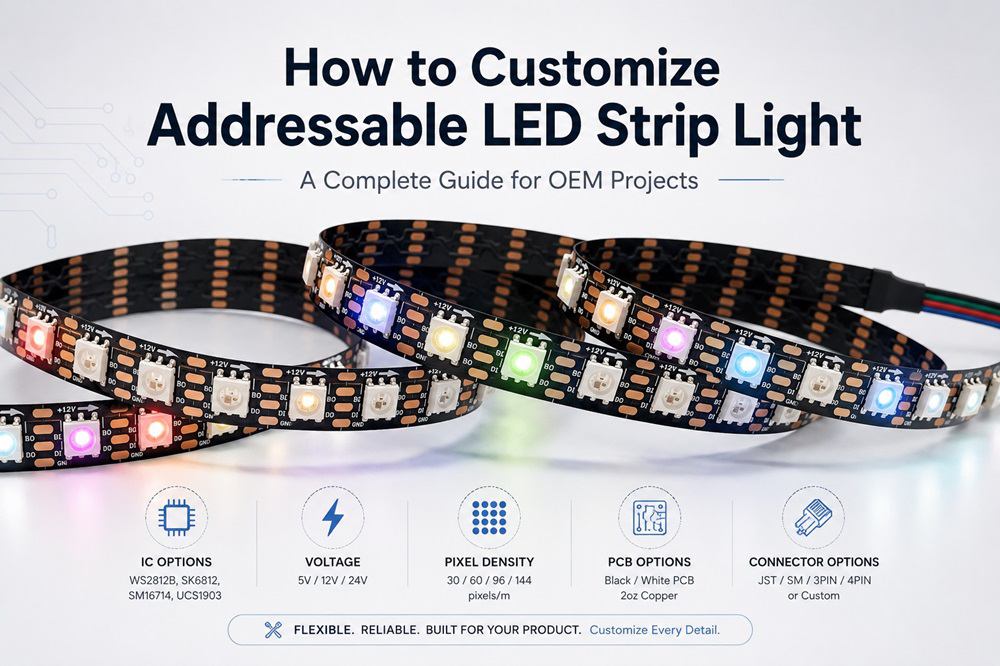
Hanron Lighting can customize addressable LED strips with different ICs, voltages, LED densities, pixel configurations, RGB/RGBW options, PCB widths and connectors according to specific project requirements.
30 vs 60 vs 96 vs 144 LEDs/m Addressable LED Strip: How to Choose Pixel Density?
High Efficacy COB LED Strip: When Does Higher lm/W Really Matter?
Related Article
Need an Instant Quote For Your Upcoming Projects?
Send us the details and we will get back to you within 12 hours.