
How to Customize Addressable LED Strip Light: A Complete Guide for OEM Projects
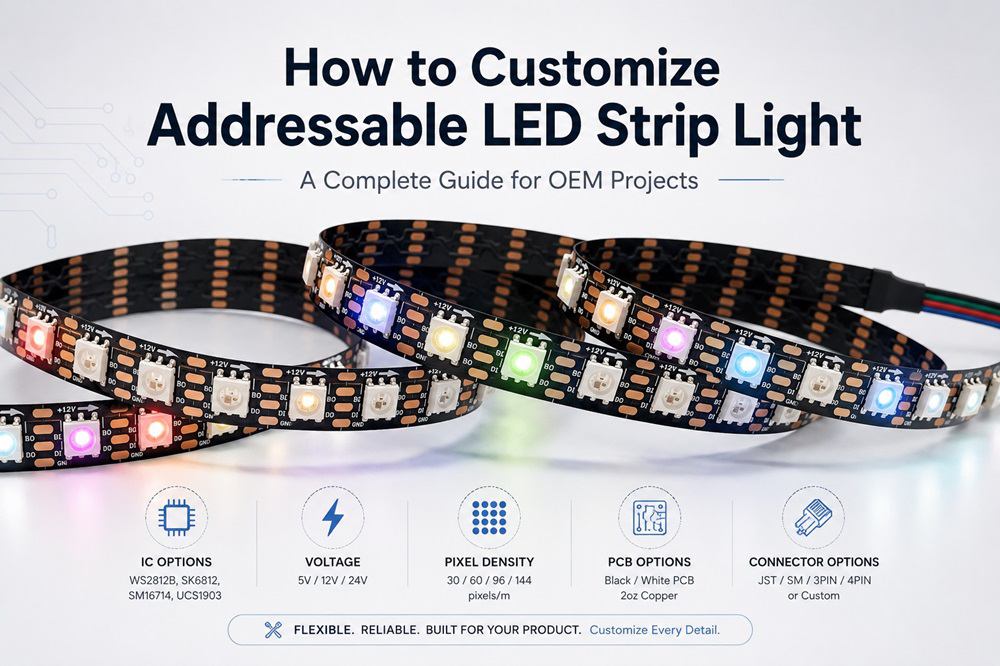
Standard addressable LED strips can meet many common lighting needs, but OEM and commercial projects often require something more specific.
A customer may need a different IC, a higher pixel density, a smaller PCB, RGBW instead of RGB, a particular voltage, side-emitting LEDs, waterproof protection, special connectors, or even a completely different pixel configuration.
What Can Be Customized on an Addressable LED Strip?
For most OEM projects, the following specifications can be adjusted according to the application:
- LED type and package
- RGB, RGBW or other color configurations
- Built-in IC or external IC
- IC model
- Operating voltage
- LEDs per meter
- Pixels per meter
- LEDs per pixel
- PCB width and layout
- Cutting length
- Power and brightness
- Signal type
- Waterproof level
- Strip length
- Wire and connector
- PCB color
- Special mechanical structure
Not every combination is technically suitable, so these specifications should be considered together rather than separately.
1. Start with the Control Requirement
Before choosing LED density, voltage or PCB width, the first question should be:
What kind of lighting effect does the project need?
Some applications only require relatively simple chasing, flowing or color-changing effects. Others need very smooth animations, high pixel resolution or synchronization with music, video or architectural control systems.
This determines the basic control architecture.
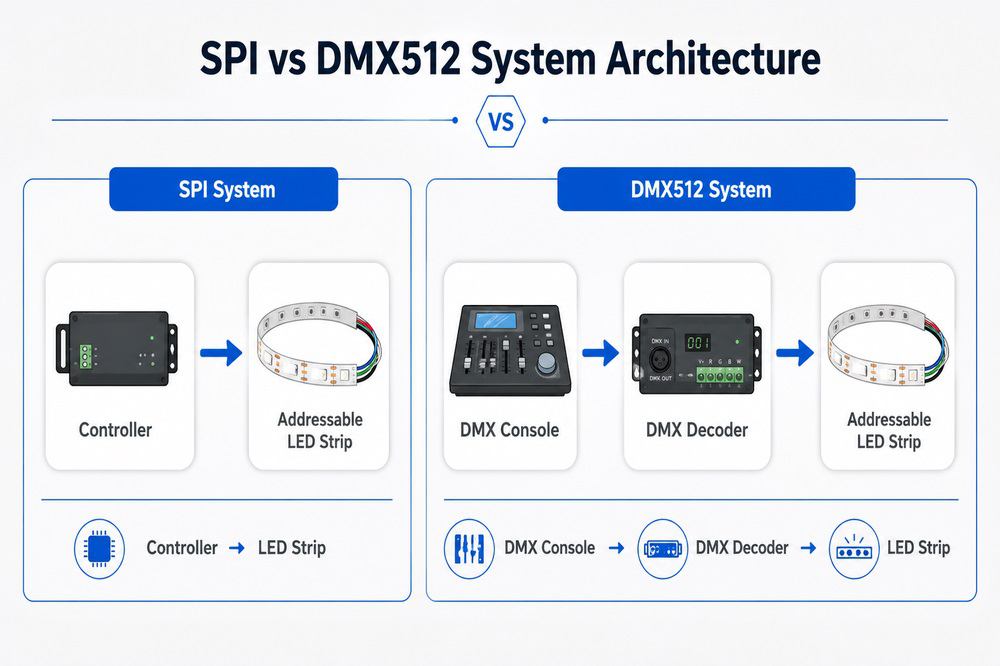
SPI Addressable LED Strip
SPI-type pixel strips are widely used because they provide flexible individual or group control and are available with many different IC families.
Depending on the IC, an SPI strip may use:
- one data signal;
- data + clock;
- main data + backup data.
WS2811, SM16703 and UCS1903 are examples commonly used in external-IC designs, while WS2812B, SK6812, WS2813 and WS2815 are examples frequently found in individually controlled designs.
Clock-based ICs such as SK9822, APA102 and HD107S can also be selected when the project requires a different data architecture or faster control.
The important point is that there is no single “best IC.” The correct choice depends on the control system, voltage, pixel density, reliability requirements and cost target.
DMX512 Addressable LED Strip
For architectural, stage and professional lighting systems, DMX512 may be preferred.
Compared with typical SPI systems, DMX512 is especially useful when the LED strip needs to become part of a larger professional lighting control network.
White, tunable white, RGB, RGBW and other DMX pixel strip configurations can be developed depending on the project.
Therefore, the first step in an OEM project is not asking:
“Do you have WS2811?”
A more useful question is:
“What control system will this strip work with, and what effect does the project need?”
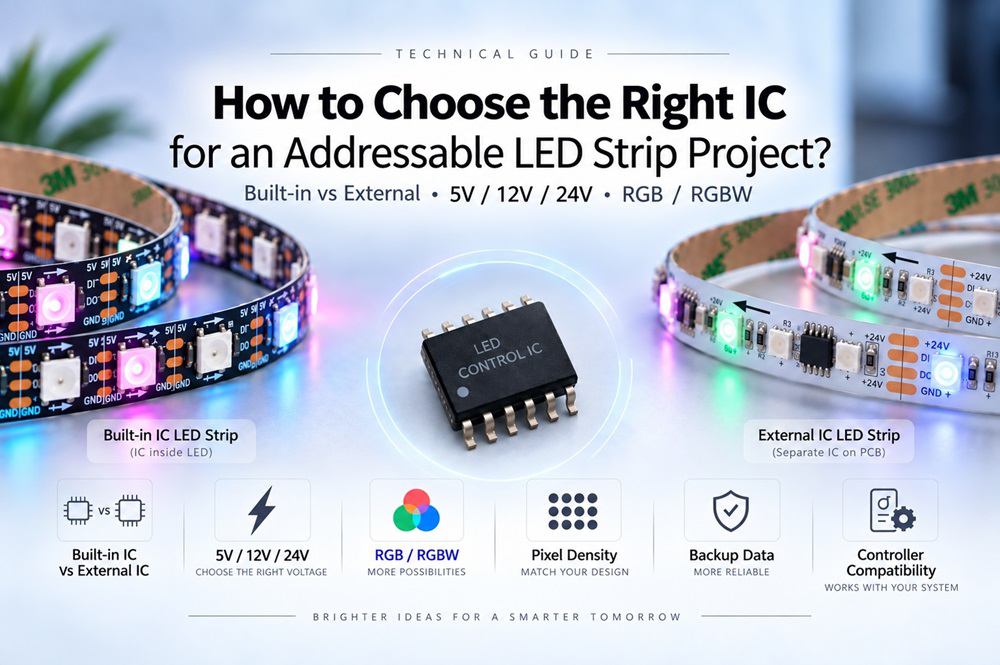
2. Built-In IC or External IC?

This is another important design decision.
Built-In IC LED Strip
With products such as WS2812B, SK6812, WS2813 or WS2815, the control IC is integrated into or closely associated with the LED package depending on the device design.
The result is a compact PCB layout and, in many cases, very high pixel density.
Built-in IC strips are particularly suitable for:
- compact installations;
- high-density pixel effects;
- decorative lighting;
- LED matrices;
- signage;
- creative lighting products.
Mini packages such as 3535 or other compact LED formats can also help when PCB space is limited.
External IC LED Strip
With external IC designs, the controller chip and LEDs are separate components on the PCB.
Typical IC options include families such as:
- WS2811
- SM16703
- UCS1903
- TM1814
- WS2814 series
- UCS2904 series
- WS2818 series
An external IC design provides more flexibility when developing different voltage, pixel grouping and LED configurations.
For example, one IC may control several LEDs as one pixel instead of controlling every LED individually.
That can be useful when the project needs longer runs or lower cost per meter but does not require every single LED to act as an independent pixel.
3. Customize the Number of LEDs and Pixels per Meter

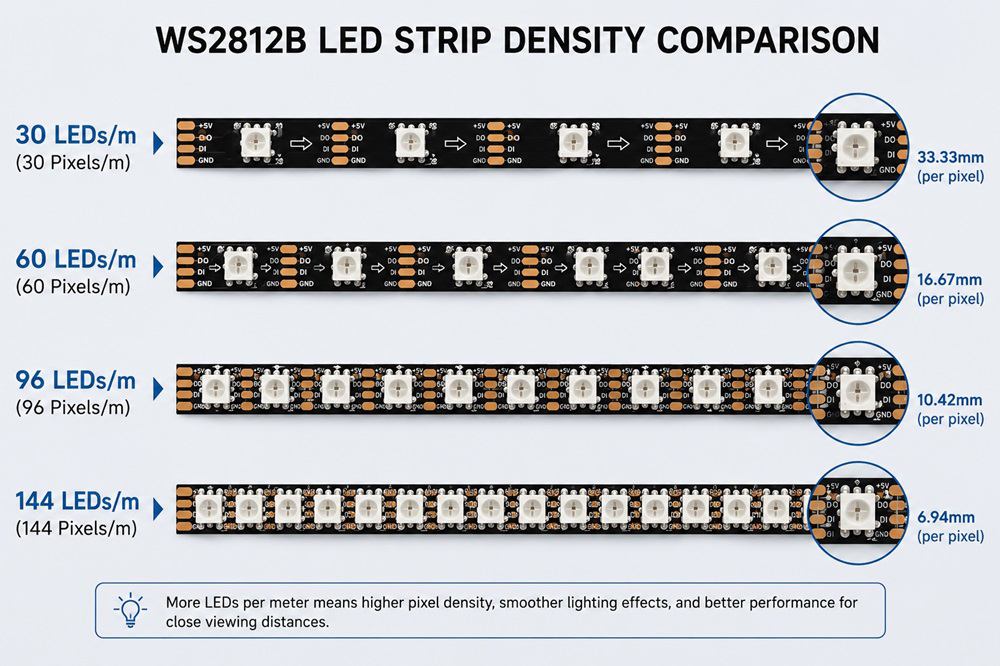
One of the most common mistakes when specifying an addressable LED strip is treating LEDs/m and pixels/m as the same specification.
They are not always the same.
Consider these two designs:
60 LEDs/m, 60 pixels/m
Every LED is individually addressable.
But another strip could be:
60 LEDs/m, 20 pixels/m
In this case, three LEDs may operate together as one pixel.
Both products have the same LED density, but their animation resolution is very different.
Higher pixel density generally produces smoother transitions and more detailed dynamic effects. Lower pixel density can reduce control complexity and may be sufficient when the strip is viewed from a longer distance.
This means pixel density should be selected according to viewing distance and visual effect, not simply by choosing the largest number available.
For an OEM project, configurations such as 30, 60, 72, 96, 120 or 144 LEDs per meter may be possible depending on the LED package, IC, PCB width and electrical design.
4. Choose the Right Operating Voltage
Addressable LED strips are commonly designed around 5V, 12V and 24V systems.
Each voltage has its own advantages.
5V
5V is common in many individually addressable LED designs because a single LED can often represent one pixel.
This makes it attractive for high-resolution effects.
The trade-off is current and voltage drop. As the installation becomes longer, power distribution becomes increasingly important.
12V
12V provides a useful balance between pixel control and power distribution.
It is widely used for commercial decorative lighting, signage, entertainment and other medium-length installations.
Depending on the circuit, several LEDs may form one pixel, although some 12V IC solutions also support more specialized configurations.
24V
For longer installations, 24V can reduce current for the same power compared with lower-voltage systems and can help improve power distribution.
However, voltage alone does not determine how many LEDs belong to one pixel or how long the strip can run without additional power.
PCB copper, power consumption, LED density, strip length and operating brightness all matter.
This is why voltage should be selected together with the complete electrical design.
5. RGB, RGBW and Other Color Configurations
Addressable LED strips are not limited to RGB.
RGB Pixel LED Strip
RGB is still the most common choice when the main goal is colorful dynamic effects.
It is suitable for:
- entertainment lighting;
- gaming environments;
- signage;
- decorative installations;
- stage effects.
RGBW Pixel LED Strip
RGBW adds a dedicated white channel.
Instead of producing white only by mixing red, green and blue, the separate white LED channel can provide a more useful white output for applications that need both dynamic colors and functional white light.
Different white color temperatures can also be considered depending on the project.
More Complex Color Systems
For some projects, customers may require adjustable white together with RGB effects.
The IC, LED package and control system must all support the required number of channels.
This is one reason OEM projects should define the final lighting function before selecting the IC.
6. PCB Width and Mechanical Design
PCB width is often overlooked during the early stages of a project.
For a normal installation, standard strip widths may be acceptable. But OEM customers may need the LED strip to fit inside:
- an aluminum profile;
- a sign;
- furniture;
- a display;
- a light fixture;
- a narrow slot;
- a custom housing.
In these cases, even a difference of a few millimeters can matter.
The PCB layout must still have enough space for LEDs, ICs, resistors, capacitors, solder pads and copper conductors.
Trying to make a very narrow PCB while maintaining high power and high LED density can create thermal and electrical limitations.
Therefore, PCB width should be considered as an engineering specification rather than only a physical dimension.
7. Front View, Side View and Mini Pixel LED Strips
Not every project needs the LEDs to emit light upward from the PCB.
Side-view addressable LED strips are useful when the installation requires light to travel sideways, such as edge lighting or installation inside certain narrow structures.
Mini LED packages can also be used when the customer needs a more compact strip or higher component density.
These designs are particularly useful for OEM products where the LED strip must become part of another finished product rather than being installed as a standalone strip.
8. Customize Waterproof Protection
The installation environment is another important part of the specification.
An indoor strip installed inside furniture does not need the same protection as a strip used outdoors or in a humid environment.
Depending on the application, different waterproof structures can be considered.
However, waterproofing changes more than the IP rating. It may also affect:
- strip dimensions;
- heat dissipation;
- flexibility;
- connector design;
- cutting and soldering;
- installation method.
For this reason, customers should specify where the strip will actually be installed instead of simply requesting “waterproof.”
9. Power Consumption and Brightness Can Also Be Adjusted
More LEDs do not automatically mean that the strip must operate at maximum power.
For OEM applications, power consumption can be designed according to the required brightness, thermal conditions and power supply capacity.
This is particularly important for addressable strips because the maximum load can become significant when many pixels display full-brightness white simultaneously.
During product development, it is useful to calculate:
Power per meter × total strip length = theoretical maximum load
The power supply and wiring should then be selected with suitable reserve capacity.
For long runs, power injection may also be necessary to reduce voltage drop and maintain consistent color and brightness.
10. Wire, Connector and Strip Length Customization
OEM customers often need a product that can be installed directly into their system.
That may include customized:
- strip length;
- input and output wires;
- wire length;
- connector type;
- male/female connectors;
- soldering position;
- cable sequence.
These details look simple, but they can significantly reduce installation time during mass production.
For equipment manufacturers, having the LED strip delivered with the correct connector and cable length can be more valuable than buying standard reels and modifying every piece manually.
A Better Way to Specify a Custom Pixel LED Strip
Instead of sending only an IC number, it is better to provide the basic project information.
For example:
| Application | Architectural decorative lighting |
| Control | SPI |
| Color | RGBW |
| Voltage | 24V preferred |
| LED density | Approx. 60 LEDs/m |
| Pixel density | 20–60 pixels/m |
| PCB width | Maximum 12 mm |
| Strip length | 5 m |
| Waterproof | Outdoor |
| Controller | Existing controller model |
| Connector | Custom 4/5-wire connector |
| Quantity | Prototype + production quantity |
With this information, the LED strip manufacturer can determine whether the requested combination is practical and suggest an appropriate IC and circuit design.
Standard Product or Custom Product?
Not every project needs customization.
A standard WS2812B, WS2815, WS2811 or SK6812 LED strip may already be suitable for many installations.
Customization becomes more valuable when the project has specific requirements for:
- dimensions;
- pixel resolution;
- voltage;
- control compatibility;
- color configuration;
- reliability;
- installation;
- wiring;
- waterproofing;
- production integration.
For OEM customers, the goal is usually not to create a different LED strip simply for the sake of being different.
The goal is to make the LED strip fit the complete lighting system.
Final Thoughts
A good custom addressable LED strip starts with the application, not the IC number.
The IC is important, but it is only one part of the system. Voltage, LED package, pixel density, PCB design, power distribution, signal type, waterproofing and control compatibility all influence the final result.
This is also why two addressable LED strips using the same IC can perform very differently in a real project.
For OEM and commercial lighting projects, the best approach is to define the required effect, installation environment, dimensions, control system and electrical requirements first. The LED strip configuration can then be developed around those conditions.
At Hanron Lighting, addressable LED strips can be customized according to different project requirements, including IC selection, LED configuration, voltage, pixel density, PCB design, strip dimensions, waterproof structure, wires and connectors.
Whether the project requires a standard SPI pixel strip, a high-density individually addressable strip, an external-IC design or a DMX512 solution, the product should ultimately be designed around the application rather than forcing the application to fit a standard strip.
SPI vs DMX512 Addressable LED Strip: Which Control System Is Better for Professional Lighting Projects?
COB LED Strip Lifetime: How Heat, Power and Installation Affect LED Strip Performance
Related Article
Need an Instant Quote For Your Upcoming Projects?
Send us the details and we will get back to you within 12 hours.