
High Efficacy COB LED Strip: When Does Higher lm/W Really Matter?
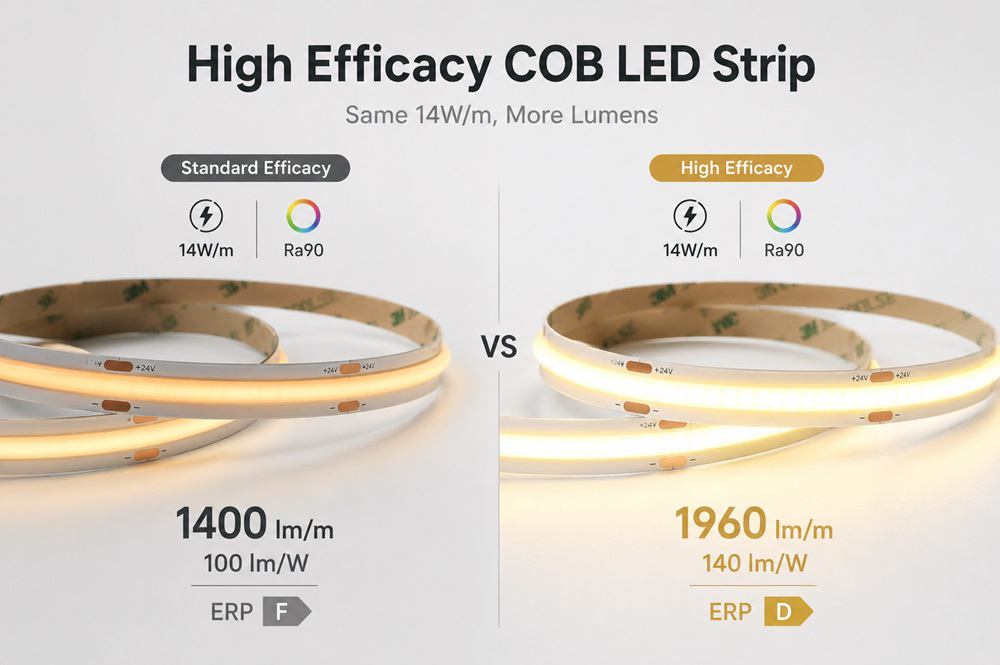
When comparing COB LED Strip products, buyers often focus on wattage and lumen output. However, another important specification is luminous efficacy, usually expressed in lm/W.
Luminous efficacy tells you how much light is produced for each watt of electrical power.
For example:
A COB LED Strip producing 1,400 lm/m at 14W/m has an efficacy of about 100 lm/W.
A high efficacy COB LED Strip producing similar brightness at 10W/m may achieve around 140 lm/W.
Both products can provide useful brightness, but the higher-efficacy version produces more light from the same amount of electrical power.
The question for B2B buyers is therefore not simply:
“Which COB LED Strip has the highest lm/W?”
A better question is:
“Does higher efficacy provide a real advantage for this project?”
Luminous efficacy measures how efficiently electrical power is converted into visible light.
The basic relationship is:
Luminous Efficacy = Lumens ÷ Watts
A higher lm/W value means the LED Strip can produce more light while consuming less power.
For professional lighting projects, this can provide several benefits:
- Lower energy consumption
- Reduced heat generation for the same lumen output
- Lower power supply load
- Better efficiency in large installations
However, efficacy should always be considered together with actual lumen output.
A 7W/m strip with very high efficacy may still produce less total light than a 20W/m high-power strip.
So:
lm/W tells you efficiency, not total brightness.
2. When Does Higher Efficacy Really Matter?
Higher efficacy becomes especially valuable in projects where the lighting operates for long periods or where many meters of LED Strip are installed.
Office and Commercial Lighting
Office linear lighting may operate 8–12 hours every day.
If hundreds of meters of COB LED Strip are installed across an office building, even a relatively small improvement in efficiency can reduce overall power consumption.
For example, if two COB strips provide similar lumen output but one requires significantly less wattage, the more efficient product can reduce:
- Electricity consumption
- Power supply capacity
- Thermal load
This makes high efficacy COB LED Strip particularly attractive for large commercial projects.
Hotels and Hospitality Projects
Hotels often use large quantities of linear and indirect lighting in:
- Corridors
- Lobbies
- Guest rooms
- Restaurants
- Public areas
Because many of these lights operate for long periods, energy efficiency becomes more important than in small residential installations.
In these projects, a high efficacy COB solution can help reduce operating costs without sacrificing lighting quality.
Professional Linear Fixtures
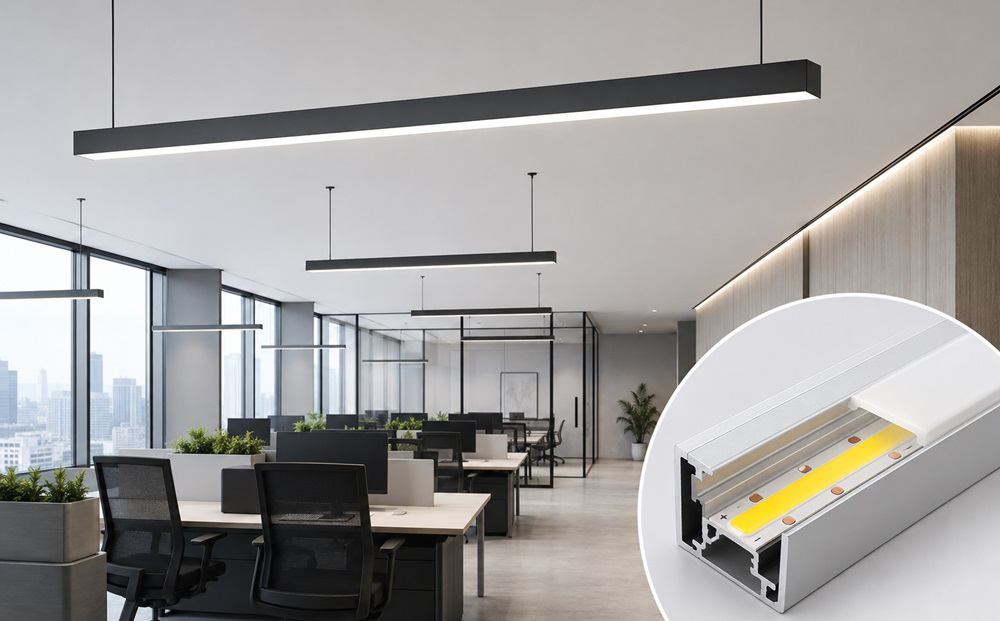
Linear fixtures usually have limited internal space.
High power density can create more heat inside the aluminum profile.
If the required brightness can be achieved with a higher-efficacy strip at lower wattage, the fixture may operate at a lower thermal load.
This can make thermal management easier and support more stable long-term performance.
3. Higher lm/W Can Help Reduce Heat
Heat and efficacy are closely related, but they should not be confused.
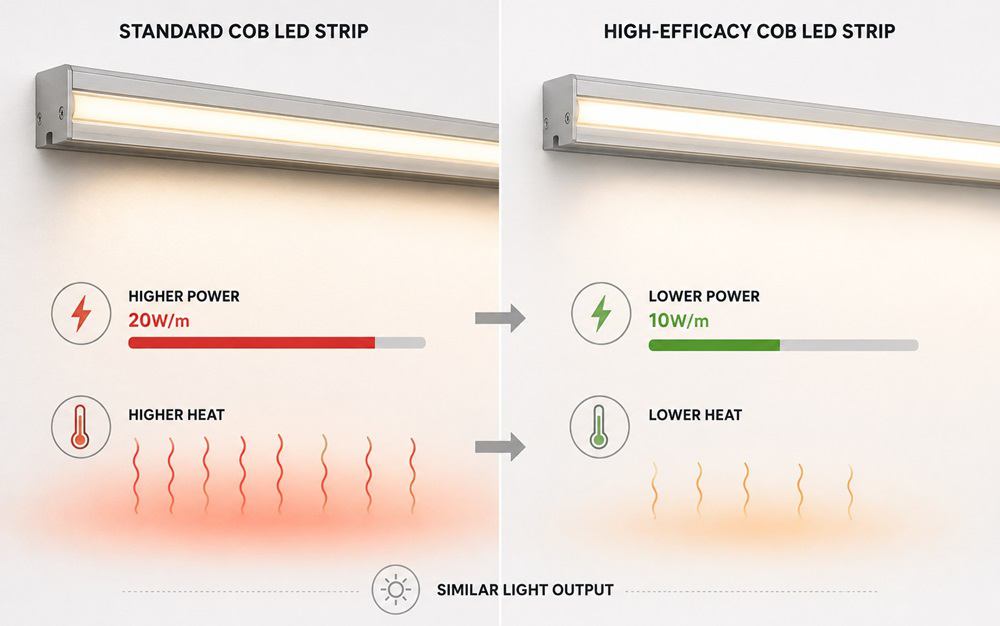
Every LED Strip generates heat during operation. A higher efficacy product converts a larger portion of electrical input into visible light, so less electrical power may be required to reach the same lumen output.
For example:
A standard COB strip may require:
14W/m to produce a certain brightness
while a high efficacy version may achieve a similar output at:
10–11W/m
The lower-power solution can generate less thermal load in the same application.
This is especially useful for:
- Narrow aluminum profiles
- Enclosed linear fixtures
- Long operating hours
- Commercial installations
However, high efficacy does not eliminate the need for thermal management.
For high-power COB LED Strip, especially products operating above 20W/m, proper aluminum profiles are still strongly recommended.
4. High Efficacy vs High Power: They Are Not the Same
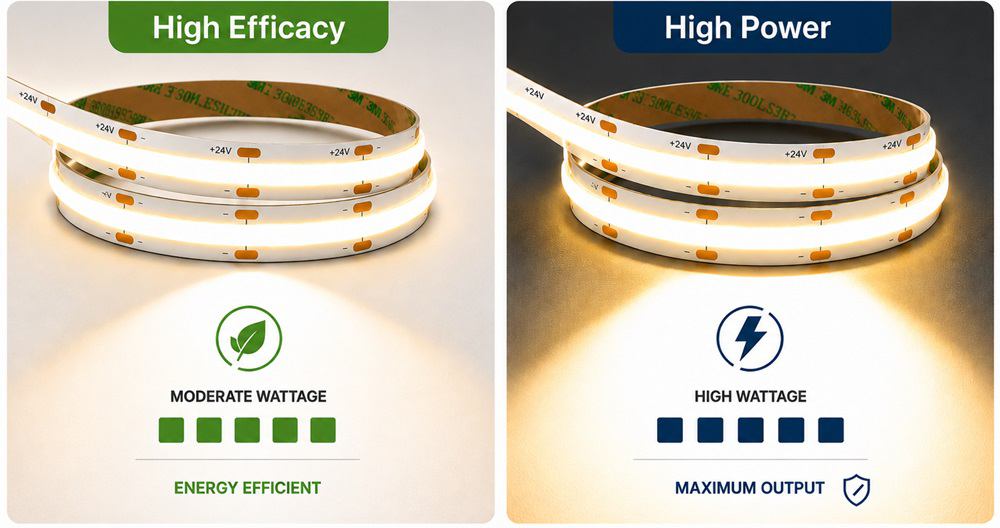
This is an important distinction for buyers.
High Power COB LED Strip focuses on achieving high total lumen output.
High Efficacy COB LED Strip focuses on producing more lumens from each watt of power.
A product can be:
- High power but moderate efficacy
- Low power but high efficacy
- High power and high efficacy at the same time
For example, a 24W/m COB strip may be selected because the project needs very high brightness.
Another project may only need moderate brightness but prioritize energy efficiency, making a 10.5W/m high efficacy COB Strip more suitable.
The correct choice depends on the lighting requirement, not simply the largest lm/W number.
5. When Standard COB LED Strip Is Already Enough
High efficacy products are useful, but they are not necessary for every application.
For short or low-power installations such as:
- Cabinet lighting
- Furniture lighting
- Small decorative projects
- Short residential installations
the difference in total electricity consumption may be very small.
If a five-meter cabinet installation only operates a few hours per day, moving from a standard COB strip to the highest-efficacy option may not provide a meaningful economic benefit.
In these applications, other factors may be more important:
- Price
- Cut length
- Strip width
- Color temperature
- CRI
- Installation flexibility
Therefore, buyers should avoid selecting high efficacy simply because the specification looks better.
6. Efficacy Can Change With CCT and CRI
Another point B2B buyers should understand is that luminous efficacy is not always identical across every color temperature and CRI option.
Very warm white products, such as 2700K or 3000K, may have slightly different efficacy from 4000K or 6000K versions.
Similarly, high CRI products often sacrifice some luminous efficacy in order to improve color rendering.
This means that comparing two products only by lm/W can sometimes be misleading.
A professional comparison should use similar conditions:
- Same or similar CCT
- Same CRI
- Similar operating power
- Similar test conditions
For example, comparing a CRI 80 4000K strip directly with a CRI 95 2700K strip based only on efficacy would not be a fair comparison.
Conclusion
Higher luminous efficacy can provide real advantages for COB LED Strip projects, but the highest lm/W value is not automatically the best choice.
High efficacy matters most when:
- Lighting operates for long periods
- Large quantities of LED Strip are installed
- Energy consumption is important
- Fixture space is limited
- Lower thermal load is beneficial
For office buildings, commercial lighting and professional linear fixtures, high efficacy COB LED Strip can offer a strong balance between brightness, power consumption and thermal performance.
For smaller decorative applications, standard COB LED Strip may already provide the right combination of brightness, cost and flexibility.
The best approach is to select the required lumen output first, then compare how efficiently different COB LED Strip options can achieve it.
In professional lighting, lm/W should be used as a decision-making tool—not simply as a number to maximize.
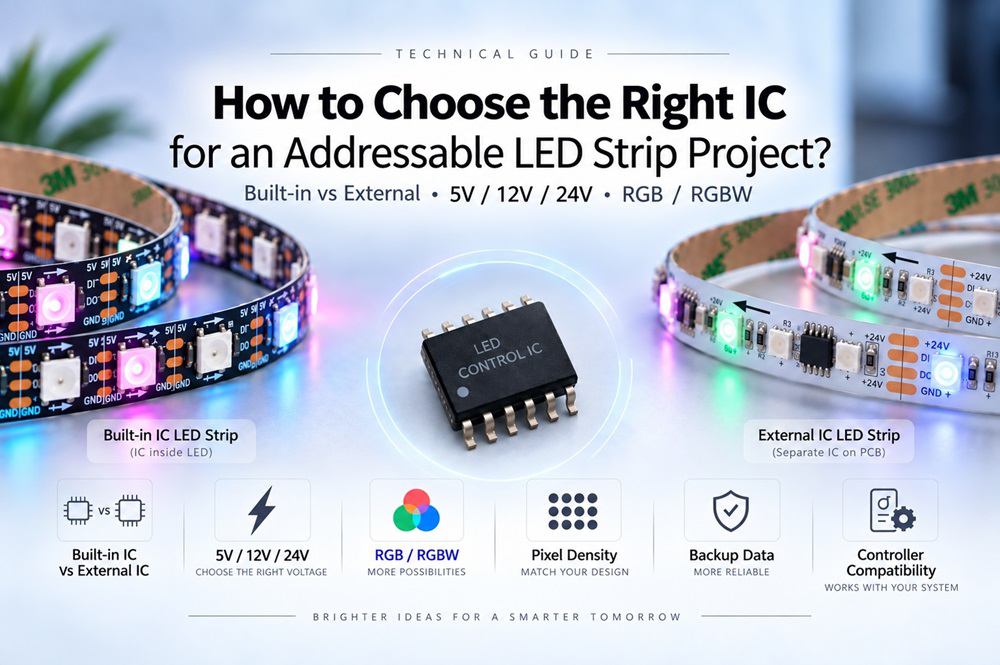
How to Choose the Right IC for an Addressable LED Strip Project?
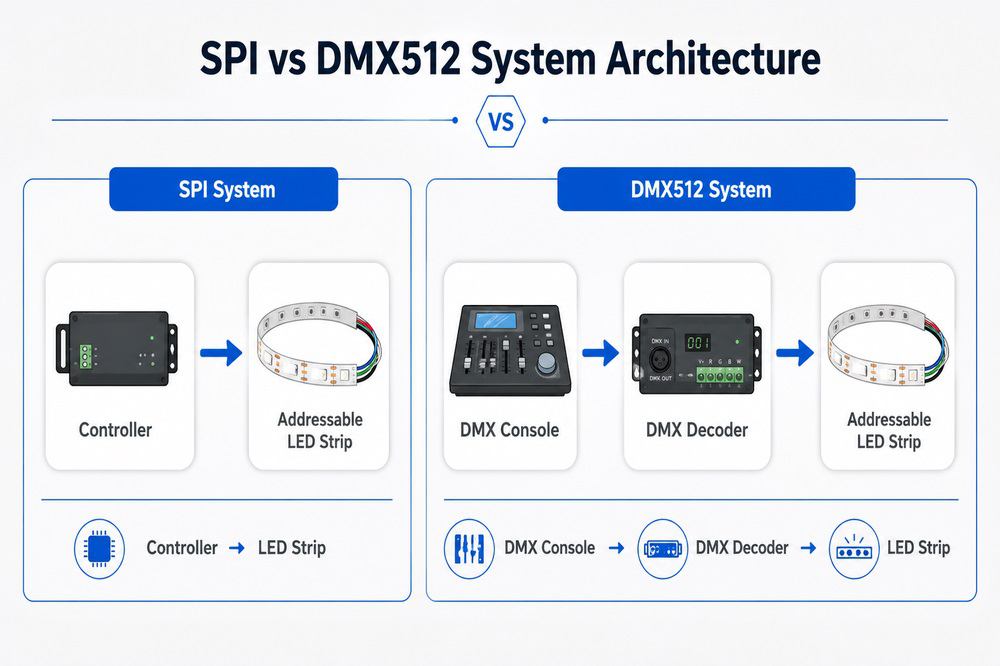
SPI vs DMX512 Addressable LED Strip: Which Control System Is Better for Professional Lighting Projects?
Related Article
Need an Instant Quote For Your Upcoming Projects?
Send us the details and we will get back to you within 12 hours.