
The ultimate guide to Dali Dimming
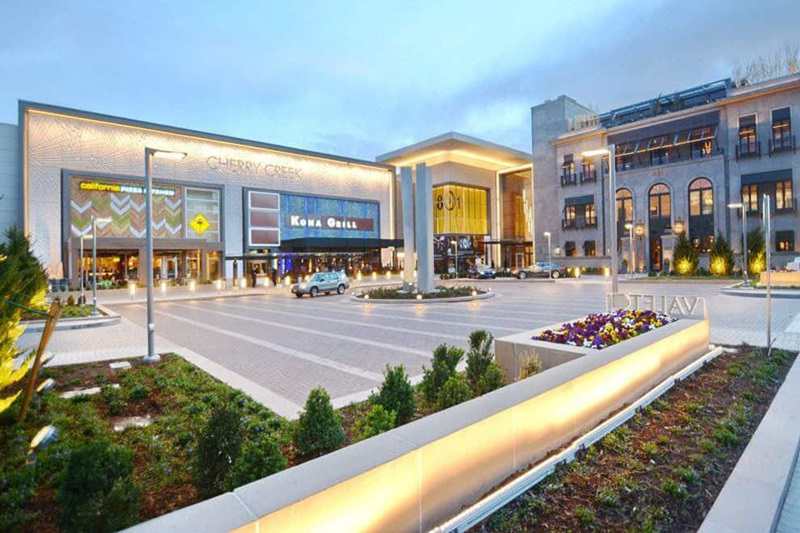
DALI, an open and supplier-independent standard, finds widespread use in lighting control within buildings. Its installation is straightforward, and its high configurability eliminates the necessity for altering device connections or wiring. This makes DALI a favored control solution for various spaces, including business premises, offices, retail establishments, restaurants, hotels, and large domestic settings.
For those seeking a deeper understanding of DALI, including its functionality and its suitability for specific projects, the following article delves into these aspects. Keep reading to gain comprehensive insights into DALI and its potential benefits for your project.
What is DALI dimming?

DALI, which stands for Digital Addressable Lighting Interface, is a protocol used for controlling lighting in buildings. DALI dimming refers to the capability of the DALI system to control the brightness (dimming level) of lighting fixtures.
In a DALI dimming system, each light fixture is assigned a unique address, allowing individual control over each fixture. This digital communication protocol enables centralized control of lighting, allowing for easy adjustment of brightness levels, creating dynamic lighting scenarios, and facilitating energy-efficient lighting management.
DALI dimming systems provide advantages such as flexibility, ease of reconfiguration, and compatibility with various types of lighting fixtures. Additionally, DALI systems often support two-way communication, allowing for feedback on the status of individual fixtures, which can be useful for monitoring and maintenance purposes.
History of DALI system
The DALI system originated in the early 1990s when the DALI Working Group was formed to address the need for a standardized protocol in the lighting industry. The first standard, IEC 60929 Ed. 1.0, was released in 2000, establishing DALI as a digital communication protocol for lighting control.
Recognized for its individual fixture addressing and bidirectional communication capabilities, DALI gained popularity in the 2000s. Subsequent updates, including the release of DALI-2 in 2014, improved interoperability and functionality. The DALI-2 certification program, introduced in 2017, ensures compliance with the latest standard.
DALI's adaptability, ease of use, and support for energy-efficient lighting have sustained its prominence, making it a widely adopted solution in commercial, industrial, and residential lighting applications.
The advantage of DALI system

DALI offers several key features that contribute to its popularity and effectiveness in lighting control systems. Some of the key features of DALI include:
Individual Device Addressing
Each lighting fixture in a DALI system is assigned a unique address, allowing for individual control and addressing.
Bi-Directional Communication
DALI supports two-way communication, enabling feedback on the status of individual fixtures. This feature is valuable for monitoring and maintenance purposes.
Dimming Control
DALI is designed for dimming control, allowing users to adjust the brightness levels of lighting fixtures according to preferences and requirements.
Flexibility in Grouping
Fixtures can be grouped flexibly in DALI systems, enabling the creation of different lighting scenes and scenarios.
Scene Control
DALI allows for the creation of pre-defined lighting scenes, making it easy to set up specific lighting conditions for different activities or times of day.
Integration with Building Management Systems (BMS)
DALI can be integrated with larger building management systems, enabling centralized control and coordination with other building automation functions.
DALI-2 Standard
The introduction of the DALI-2 standard brings enhanced interoperability, additional device types, and improved functionality to DALI systems.
Open Standard
DALI is an open standard, promoting compatibility and interoperability among products from different manufacturers.
What Components Make Up the DALI Dimming System?

A DALI dimming system comprises several key components that work together to enable precise control and dimming of lighting fixtures. Here are the main components of a DALI dimming system:
DALI Controller
The DALI controller is the device or system responsible for sending digital signals to DALI-compatible fixtures. Controllers can be physical devices, such as wall-mounted panels or remote controls, or software-based interfaces integrated into larger building management systems.
DALI Ballasts or Drivers
DALI-compatible ballasts or drivers are essential components for controlling the electrical output to fluorescent lamps or LED fixtures. These devices receive dimming commands from the DALI controller and adjust the light output accordingly.
DALI-compatible Fixtures
Lighting fixtures designed to work with DALI systems are equipped with DALI-compatible ballasts or drivers. These fixtures can be individually addressed and controlled within the DALI network.
DALI Power Supply
A DALI power supply provides the necessary voltage for communication and control signals in the DALI network. It ensures that DALI devices, including controllers and fixtures, receive the power they need to function.
DALI Gateway or Interface
In some installations, a DALI gateway or interface may be used to bridge the DALI system with other building automation protocols, such as BACnet or Modbus. This allows for integration with broader building management systems.
DALI Bus Wiring
The DALI bus is a two-wire communication network that connects all DALI devices in the system. It is used for transmitting digital signals between the controller and the DALI-compatible fixtures.
DALI Sensors
Optional DALI-compatible sensors, such as occupancy sensors or daylight sensors, can be integrated into the system. These sensors provide feedback to the controller and allow for automatic adjustments based on occupancy or ambient light levels.
DALI Scene Selector
Scene selectors are user interfaces that allow occupants to manually select predefined lighting scenes. These interfaces can be part of the DALI controller or separate devices.
DALI Software
In larger installations or those integrated with building management systems, software may be used for programming, monitoring, and controlling the DALI system. This software facilitates advanced scheduling, scene programming, and energy management.
DALI-2 Certification
DALI-2 is an updated standard that ensures interoperability between DALI devices from different manufacturers. DALI-2 certified components carry a mark indicating compliance with the latest standard.
These components work together to form a DALI dimming system, providing users with the flexibility to control individual fixtures, create lighting scenes, and achieve energy-efficient lighting solutions.
HOW DO YOU WIRE A DALI LED CONTROL SYSTEM?
1. DALI LED control system with different types of lighting

2. DALI LED control system with sensor

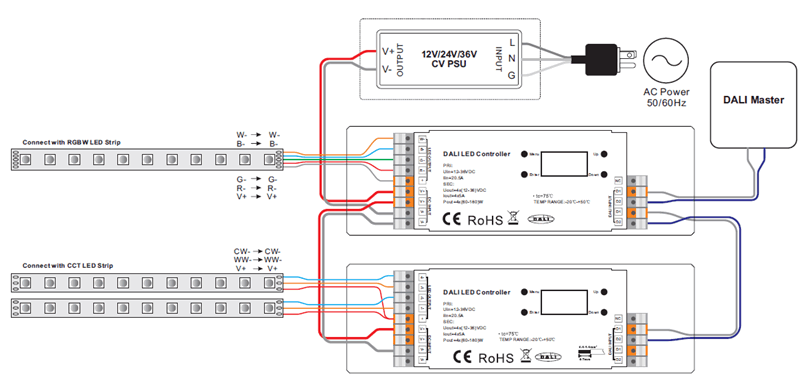
3. Typical wiring of DALI LED control system for led strip light

What’s the Difference between DALI and 1-10 V
Despite the many differences, these two can also similar. For example, many manufactures can offer you a wide range of lighting control devices such as LED drivers that contain both DALI and 1-10 V interfaces. Their main differences include:
| Items | DALI | 1- 10 V |
| Communication | It’s digital | It’s analogue |
| Control Functions | Offers a wide range of functions such as emergency light testing and feedback, colour-changing apart from the normal on/off switching and simple dimming. | It only offers the switching on/off and simple dimming functions. |
| Interoperability | DALI dimming curve is standardized, meaning that you can use drivers from different manufactures on the same diming channel for consistent results. | Its curve is non-standardized. Therefore when you use different brands of drivers on the same dimming channel you can end up with inconsistent diming results. |
| Addressability | It can respond to commands sent to different addresses/ devices. Therefore, you can enjoy features such as grouping, scene-setting and configuring your light fittings to match your room layouts. | It’s not addressable. Therefore you cannot enjoy the other features. |
Disadvantages of DALI Dimming Control
While DALI (Digital Addressable Lighting Interface) dimming control offers numerous advantages, there are also some potential disadvantages to consider:
Cost
Implementation of a DALI system, including the purchase of DALI-compatible fixtures and control devices, may involve higher upfront costs compared to traditional lighting control systems.
Complexity
DALI systems, especially in larger installations, can be more complex to design and configure. This complexity may require skilled professionals for installation and commissioning.
Compatibility Issues
While DALI is an open standard, compatibility issues can still arise when integrating products from different manufacturers. Ensuring that all devices are DALI-2 compliant can mitigate this issue.
Limited Power Capacity
DALI has limitations in terms of power capacity for individual fixtures. In high-power applications, additional infrastructure may be required, potentially increasing costs.
Dependency on Control Devices
DALI systems depend on DALI-compatible control devices for operation. If there is a failure in the control device, it can impact the functionality of the entire lighting system.
Potential Interference
Electronic interference from other devices or systems may affect the performance of DALI systems, leading to communication issues or disruptions in lighting control.
Despite these potential disadvantages, many of them can be mitigated through proper planning, installation, and ongoing maintenance. DALI remains a widely used and effective solution for lighting control in various applications.
Where is DALI dimming Commonly Used?

DALI dimming is commonly used in a variety of applications and settings where flexible and precise control over lighting is desired. Some common areas where DALI dimming is implemented include:
Commercial Buildings
DALI is widely used in commercial spaces such as offices, conference rooms, lobbies, and retail stores. It allows for dynamic lighting control to create comfortable and efficient environments.
Educational Institutions
Schools, colleges, and universities often utilize DALI dimming for classrooms, auditoriums, libraries, and other spaces. The ability to create different lighting scenes is beneficial for various activities.
Healthcare Facilities
Hospitals and healthcare facilities employ DALI dimming for patient rooms, waiting areas, and corridors. Dimming can be adjusted to accommodate different patient needs and provide a calming atmosphere.
Hospitality Industry
Hotels, restaurants, and hospitality venues use DALI dimming for guest rooms, dining areas, and common spaces. It allows for mood lighting and enhances the overall guest experience.
Residential Spaces
In high-end residential buildings and smart homes, DALI dimming is employed for living rooms, bedrooms, kitchens, and outdoor spaces. Homeowners benefit from the ability to customize lighting scenes for different activities.
Cultural and Entertainment Venues
Theatres, concert halls, museums, and galleries use DALI dimming to create dramatic lighting effects, highlight exhibits, and adapt lighting conditions for different events.
Industrial Facilities
In manufacturing and industrial settings, DALI dimming can be used for both general lighting and task-specific lighting. It contributes to energy efficiency by allowing precise control over illumination levels.
Public Spaces
DALI is implemented in public spaces such as libraries, community centers, and government buildings. It enables efficient lighting control and contributes to energy savings.
Sports Facilities
Stadiums, gyms, and sports complexes utilize DALI dimming for varying lighting needs during different events or activities. The ability to adjust lighting levels enhances both functionality and energy efficiency.
Transportation Hubs
Airports, train stations, and bus terminals use DALI dimming for lighting control in waiting areas, corridors, and other public spaces. It enhances the overall ambiance and energy management.
DALI's adaptability, individual fixture control, and support for dynamic lighting scenarios make it suitable for a wide range of applications where advanced lighting control is desired.
How many metres of LED strip can I run off a DALI 8amp or DALI 4 x 5amp receiver?
|
PRODUCT TO BE CONTROLLED |
1X8AMP – LED TAPE MAX LENGTH |
4X5AMP – LED TAPE MAX LENGTH |
|
12v, 5 watt White LED Strip |
19.2 metres |
12 metres |
|
12v, 7.5 watt RGB LED Strip |
— |
24 metres |
|
12v, 10 watt White / RGBW LED Strip |
9.6 metres / — |
6 metres / 24 metres |
|
24v, 12 watt White / Dual-White LED Strip |
16 metres / — |
10 metres / 20 metres |
|
24v, 15 watt Single-Colour / RGB LED Strip |
12.8 metres / — |
8 metres / 24 metres |
|
24v, 20 watt White / RGBW LED Strip |
9.6 metres / — |
6 metres / 24 metres |
|
24v 24 watt White / Dual-White LED Strip |
8 metres / — |
5 metres / 10 metres |
People also ask
DALI is a standardized protocol used for controlling and dimming lighting in buildings.
DALI allows for individual addressing of lighting fixtures and supports two-way communication, providing more flexibility and control compared to some other systems.
Yes, DALI can be integrated with building management systems (BMS) and other automation protocols through gateways or interfaces.
DALI is compatible with various light sources, including fluorescent lamps, LEDs, and other technologies.
DALI can be used for outdoor lighting in various settings such as gardens, pathways, and building facades where advanced control features are desired.
DALI-compatible sensors, such as occupancy or daylight sensors, provide feedback to the DALI system. They are integrated by connecting them to the DALI bus, allowing for automatic adjustments based on occupancy or ambient light levels.
What is full spectrum light?
Do LED Lights Attract Spiders?
Related Article
Need an Instant Quote For Your Upcoming Projects?
Send us the details and we will get back to you within 12 hours.