
How to Use a 12V LED Strip in a 24V System Without Damaging It
When planning an LED lighting project, one of the most important things to check is voltage compatibility. A common problem happens when you already have a 24V power supply, but the LED strip you want to use is rated for 12V.
So, can a 12V LED strip be used in a 24V system?
The answer is yes, but not by connecting it directly. A direct connection will almost certainly damage the strip. However, there are a few practical ways to make a 12V LED strip work safely in a 24V setup.
This article explains how it works, why voltage matching matters, and which solutions are the safest for real projects.
Why Voltage Matching Matters
LED strips are designed to run at a specific input voltage, usually 12V or 24V. The power supply must match that voltage so the LEDs receive the correct amount of electrical energy.
If a 12V LED strip is connected straight to a 24V power supply, the strip receives double its rated voltage. This can lead to:
- Immediate overheating
- Burned LEDs or resistors
- Permanent performance loss
- Complete strip failure
In simple terms, a 12V strip should never be powered directly by 24V.
How a 12V LED Strip Is Built
Although an LED strip looks like one long continuous circuit, a standard 12V strip is usually made of many small repeating sections connected in parallel.
Each section typically contains:

- 3 LEDs in series
- 1 or 2 current-limiting resistor
Together, each section is designed to operate from a 12V supply. That is why the copper pads along the strip are intended for 12V input, not 24V.
Understanding this structure helps explain why direct overvoltage is dangerous, and why certain workaround methods can work.
Can You Use a 12V LED Strip in a 24V System?
Yes, but only with the correct method. There are several possible solutions, and the right one depends on whether your setup is temporary, permanent, low-cost, or performance-focused.
Option 1: Use a DC-DC Buck Converter

The safest and most reliable method is to use a DC-DC step-down converter, also called a buck converter. This device reduces the 24V input to a stable 12V output before the power reaches the LED strip.
Advantages
- Safe and stable
- Suitable for long-term use
- Preserves normal strip performance
- Easy to find in different power ratings
Things to watch
- The converter must be rated for enough current and wattage
- Proper installation and cooling are important
A good rule is to choose a converter with at least 20% extra capacity above the LED strip’s actual power draw.
For most professional or permanent installations, this is usually the best solution.
Option 2: Connect Two Identical 12V LED Strips in Series
Another method is to connect two identical 12V LED strip segments in series across the 24V power supply.
How series wiring works
In a series connection, the voltage is shared across both strips. If the two strip segments are truly identical, each one will drop about 12V, allowing both to operate safely from a 24V source.
The wiring layout is:

When this is done correctly, the total 24V is divided between the two strips.
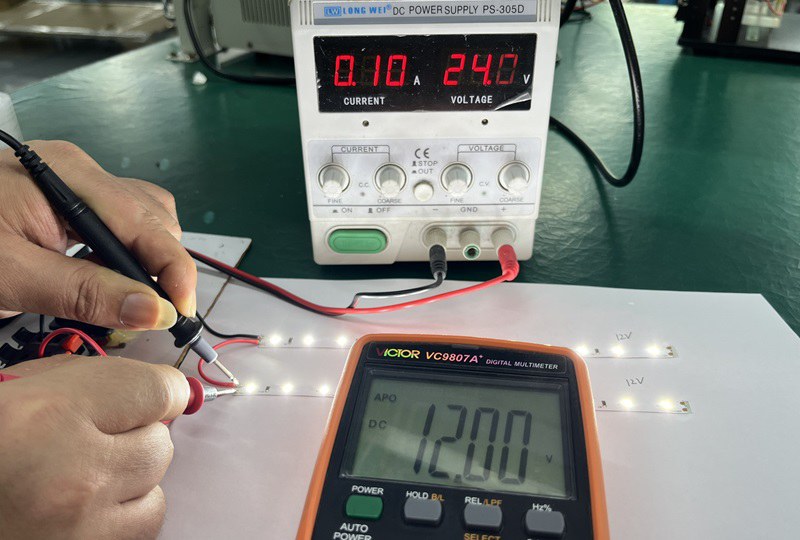
Practical test result
In a real-world test using two identical 12V LED strips wired on a regulated 24V bench power supply, the measured values were:

Power supply voltage: 12.0V DC
Current draw: 0.2A
Total power output: 2.4W
At the same time, we do the test using two identical 12V LED strips wired in series on a regulated 24V bench power supply, the measured values were:

Power supply voltage: 24.0V DC
Current draw: 0.1A
Total power output: 2.4W
Voltage across each strip: 12V
This shows that the method can work well under controlled conditions.
Why the Two Strips Must Be Identical
This is the most important rule for series wiring.
The two strips must have:
- The same voltage rating
- The same strip type
- The same length
- The same LED density and power draw
Ideally the same cable length and connection conditions
Why does this matter?
Because in a series circuit, both strips are forced to carry the same current. If the strips are different, the voltage may not divide evenly. One strip may end up receiving less than 12V, while the other is forced to take more than 12V. That can create an overcurrent or overvoltage condition, which may damage the strip.
For example, if one strip normally draws 0.5A and another normally draws 1.0A, connecting them in series creates an electrical mismatch. The system will no longer divide voltage cleanly, and one strip may be overstressed.
So, this method only works safely when both strip segments are truly matched.
Important Warning: Do Not Use Parallel Wiring
A common mistake is to connect two 12V LED strips in parallel to a 24V power supply.
This is wrong.
In a parallel connection, each strip receives the full supply voltage. That means each 12V strip would be exposed directly to 24V, which will likely burn it out almost immediately.
So if you are using a 24V power supply with 12V strips:
Series connection may work
Parallel connection will not
Option 3: Use a Separate 12V Power Supply
If your project includes both 12V and 24V components, another safe solution is to keep the 12V LED strip on its own 12V power supply.
Advantages
- Very safe
- Easy to understand
- Good for mixed-voltage projects
Disadvantages
Requires another power supply
Adds some wiring and hardware complexity
This is often a practical solution for installations with separate lighting zones.
Option 4: Replace the Strip with a 24V LED Strip
In some cases, the most efficient answer is simply to switch to a 24V LED strip.
Why this can be better
Matches the existing power system
Simplifies wiring
Usually performs better over longer runs
Often reduces voltage drop compared with 12V strips
If the lighting system is being designed for long-term use, upgrading to 24V may be the cleanest and most scalable option.
What Happens If You Accidentally Connect 24V to a 12V Strip?
If a 12V LED strip is connected directly to 24V, the results are usually immediate:
LEDs may become extremely hot
Resistors may overload
Light output may spike briefly and then fail
The strip may blacken, dim permanently, or stop working entirely
In most cases, the damage is irreversible.
That is why it is always a good idea to test with a small section first if you are trying an unconventional setup.
When Series Wiring Makes Sense
Using two identical 12V strips in series can be useful when:
You already have a 24V power supply
You only have 12V strips available
You want a simple no-converter solution
You are building a test setup, demo, or lightbox
The strips are perfectly matched
When You Should Avoid Series Wiring
This method is not a good choice when:
The strips are different lengths or types
You are not confident about polarity and wiring
The setup is intended for critical long-term installation
You want maximum reliability
The strips may age differently over time
Although the series method can work, it is still less robust than using a proper voltage converter or matched power supply.
Can the Same Idea Be Expanded?
Yes. In theory, the same approach can be extended:
Three identical 12V strips in series on 36V
Four identical 12V strips in series on 48V
But the same rule always applies: all strips must be identical, and they must be wired in series correctly.
Final Thoughts
A 12V LED strip should never be connected directly to a 24V power supply. That will usually destroy the strip.
However, there are safe ways to use a 12V strip in a 24V system:
Use a buck converter to step 24V down to 12V
Connect two identical 12V strips in series
Use a separate 12V power supply
Replace the strip with a 24V LED strip
For temporary or low-cost situations, the series method can work well if done carefully. For permanent installations, a voltage converter or a proper matching power supply is usually the safer and more professional choice.
Disclaimer
Incorrect wiring or accidental overvoltage can permanently damage LED strips and may create safety risks. Any non-standard wiring method should be tested carefully using a short strip segment before full installation.
How to wire a RGB LED Strip Light?
How to wire tunable white or CCT adjustable LED Strip?
Related Article
Need an Instant Quote For Your Upcoming Projects?
Send us the details and we will get back to you within 12 hours.