
LM-80 vs LM-79 vs ISTMT vs TM-21 vs LM-82 in LED Test Reports
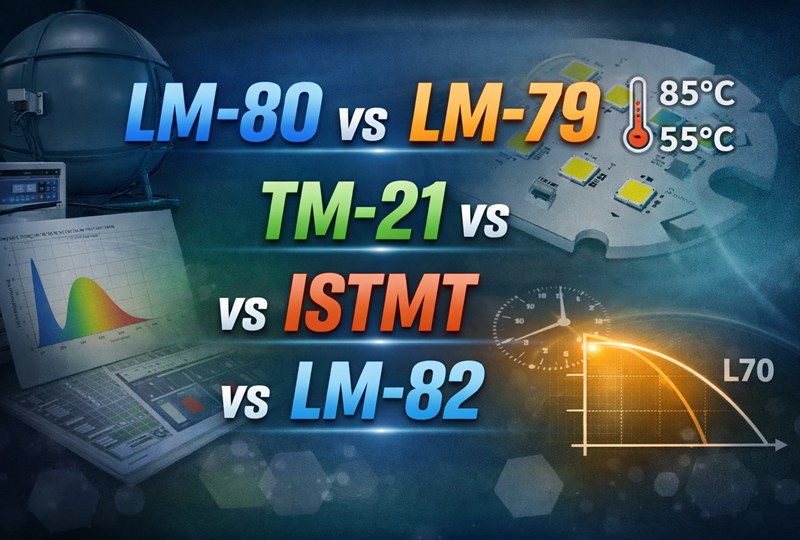
In the LED lighting industry, test reports such as LM-80, LM-79, ISTMT, TM-21, and LM-82 are frequently mentioned in product specifications, certification applications, and customer inquiries. Because the names are similar, many buyers and even some new manufacturers confuse them or assume they measure the same thing. In fact, each report answers a different question about LED performance.
A simple way to understand them is this: LM-79 tells you how the complete lamp or luminaire performs, LM-80 tells you how the LED light source maintains its lumen output over time, ISTMT tells you the LED temperature inside the actual fixture, TM-21 uses LM-80 data to project lumen maintenance life, and LM-82 shows how performance changes when temperature rises. Once these roles are clear, it becomes much easier to understand which report is needed for which project or certification.
What Is LM-79?
LM-79 is the IES approved method for measuring the electrical and photometric performance of complete solid-state lighting products. In other words, it is used for the whole product, such as an LED luminaire or an integrated LED lamp, not just the LED chip or module. The PDF you provided also makes this point very clearly: LM-79 applies to LED-based products with their control electronics and heat sinks included, and it requires complete luminaire testing rather than separate component testing.
An LM-79 report usually includes the most important performance data that buyers care about at the product level. This normally covers total luminous flux, electrical power, luminous efficacy, light distribution, and color characteristics such as CCT, CRI, and chromaticity. In practical business terms, LM-79 is the report that helps customers compare one finished LED product with another.
However, LM-79 has a clear limitation. It shows how a product performs at a specific test point, usually under controlled laboratory conditions, but it does not tell you how long the product will maintain its light output. It is not a lifetime report, and it does not measure LED temperature inside the fixture over long-term operation. That is why LM-79 alone is not enough when a customer asks about lumen maintenance life.

What Is LM-80?
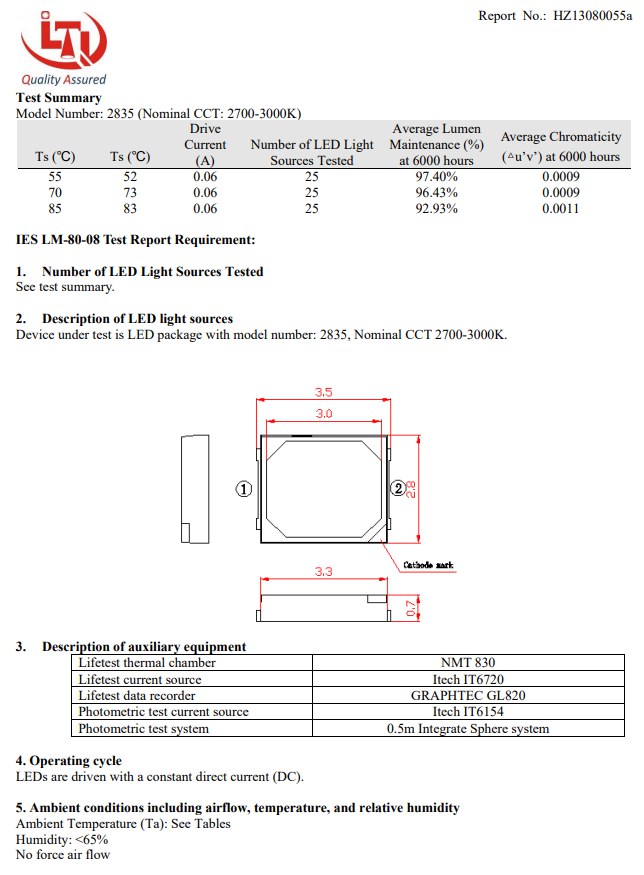
LM-80 is very different from LM-79. It is not for the whole luminaire. Instead, it is the IES method for measuring the lumen maintenance of LED light sources, including LED packages, arrays, and modules. The PDF states this directly and also notes that LM-80 does not cover luminaires and does not itself provide a method for estimating lifetime.
This matters a lot because LEDs usually do not fail in the same way as traditional lamps. They often continue operating, but their light output gradually drops. LM-80 is designed to record that depreciation over time. The test is normally conducted at multiple case temperatures, commonly 55°C, 85°C, and one additional manufacturer-selected temperature, and the testing period is at least 6,000 hours, with 10,000 hours preferred. Measurements are usually taken at regular intervals such as every 1,000 hours. The same PDF highlights these conditions and intervals as part of the LM-80 method.
An LM-80 report is therefore a component-level report, not a system-level report. It provides valuable data about how the LED source behaves under controlled thermal and electrical conditions, including lumen maintenance and chromaticity shift over time. But it still does not tell you the actual life of the finished lamp or luminaire by itself.
What Is ISTMT?
ISTMT stands for In-Situ Temperature Measurement Test. This report measures the actual operating temperature of the LED inside the finished luminaire or lamp. Put more simply, it tells you how hot the LED really gets when the product is running in its real product structure.
This report is important because LED performance and lumen maintenance are strongly affected by temperature. Even if an LED package has a very good LM-80 report, the final product may not deliver the same long-term performance if the thermal design of the luminaire is poor. That is exactly why ISTMT acts as the bridge between component-level testing and real fixture performance.
During ISTMT, the temperature is measured at the LED temperature measurement point specified by the LED manufacturer. The result is then compared with the temperatures used in the LM-80 report. If the in-situ temperature of the luminaire falls within the LM-80 tested temperature range, the data can be used for further lumen maintenance projection. So, ISTMT is not mainly about brightness or efficacy. Its core value is to provide the real thermal condition needed for lifetime estimation.
What Is TM-21?
TM-21 is often misunderstood, so this part needs to be very clear. TM-21 is not a physical test. It is a calculation method used to project the long-term lumen maintenance of LED light sources based on LM-80 data. The PDF stresses this idea in several places: TM-21 does not determine the traditional “time to failure” of an LED lighting system, but it does project the lumen maintenance of an LED package, array, or module.
In simple terms, TM-21 takes the measured lumen depreciation data from LM-80 and uses a mathematical model to estimate future lumen maintenance. The same PDF explains several key rules behind this process. For example, when LM-80 data covers 6,000 to 10,000 hours, TM-21 uses the last 5,000 hours for curve fitting. When LM-80 data is longer than 10,000 hours, it uses the last half of the collected data. It also limits projection length, and with a sample size of 20, the reported projection is generally limited to six times the test duration.
This is why TM-21 results are usually written in forms such as L70(6k) or L70(10k). For example, L70 means the point when the light output is projected to remain at 70% of its initial value. The number in brackets shows the LM-80 test duration used as the basis of that projection. Again, this is not the same as proving that the whole luminaire will physically survive for that many hours. It is a lumen maintenance projection, not a full product durability guarantee.

How Are ISTMT and TM-21 Connected?
This is one of the most important relationships in LED testing. LM-80 gives you the lumen maintenance behavior of the LED source under specific temperatures. ISTMT tells you the real LED temperature inside the finished product. TM-21 then uses the LM-80 data at the relevant temperature to project lumen maintenance life.
The PDF explains that the in-situ temperature must fall within the LM-80 tested temperature range, and interpolation between tested temperatures can be made using the Arrhenius approach. It also notes that extrapolation outside the LM-80 temperature range is not recommended or supported. In practice, this means a manufacturer cannot simply take any good LM-80 report and claim a lifetime for any fixture. The actual thermal condition of the finished product must still be verified.
So, when someone asks how to estimate the life of an LED luminaire, the normal logic is not “LM-79 only.” The more complete path is often LM-80 + ISTMT + TM-21.
What Is LM-82?
LM-82 is used to evaluate the electrical and photometric performance of LED light engines and integrated LED lamps at elevated temperatures. Compared with LM-79, which is usually performed under a standard ambient condition around 25°C, LM-82 is more focused on how performance changes when temperature rises.
That makes LM-82 especially useful when a product may work in hotter operating environments or when a customer wants to understand how temperature affects output, power, and color. In a typical LM-82 style evaluation, the product is first tested under normal conditions and then tested again under higher thermal conditions so changes in light output and related parameters can be compared.
So, while LM-79 tells you the product’s standard photometric and electrical performance, LM-82 goes a step further by showing temperature sensitivity. This is valuable for thermal design evaluation, product development, and certain application environments where heat can significantly affect performance.
LM-79 vs LM-80 vs ISTMT vs TM-21 vs LM-82: The Main Difference
The easiest way to separate these reports is by asking what each one is really trying to answer.
LM-79 asks: How does the finished LED lamp or luminaire perform right now?
LM-80 asks: How does the LED package, array, or module maintain its lumen output over time?
ISTMT asks: What is the actual LED operating temperature inside the finished product?
TM-21 asks: Based on LM-80 data, what lumen maintenance life can be projected?
LM-82 asks: How does product performance change when temperature increases?
That is why these reports are not interchangeable. An LM-79 report cannot replace LM-80. An LM-80 report cannot replace LM-79. TM-21 cannot exist as a stand-alone physical test, because it depends on LM-80 data. And ISTMT is essential when you want to relate LED source data to the real thermal condition inside a luminaire.
Why Do These Reports Matter for Certification and Marketing?
In many energy efficiency and lighting certification programs, these reports are used together rather than individually. LM-79 is often required to prove product-level optical and electrical performance. LM-80 supports the reliability background of the LED source. ISTMT helps confirm that the source operates within an acceptable thermal range inside the actual product. TM-21 is then used to support lumen maintenance claims. LM-82 can provide additional evidence about thermal performance under elevated temperature conditions.
From a marketing point of view, understanding these reports also helps manufacturers answer customer questions more professionally. For example, when a buyer asks whether a fixture has a 50,000-hour lifetime, the best reply is usually not just “we have LM-79.” A more credible answer explains the lifetime claim through LM-80 source data, ISTMT temperature verification, and TM-21 lumen maintenance projection.
Conclusion
LM-79, LM-80, ISTMT, TM-21, and LM-82 each play a different role in LED product evaluation. LM-79 focuses on the finished product, LM-80 focuses on the LED light source, ISTMT focuses on the actual thermal condition inside the product, TM-21 focuses on lumen maintenance projection, and LM-82 focuses on performance at elevated temperatures.
For manufacturers, buyers, and certification teams, the key is not choosing one report over another, but understanding how they work together. Once that relationship is clear, product testing, certification planning, and customer communication all become much easier.
Pros and Cons of a 12V LED System
Related Article

Need an Instant Quote For Your Upcoming Projects?
Send us the details and we will get back to you within 12 hours.