
COB LED Strip Installation Guide: Aluminum Profile, Heat Dissipation and Power Supply Selection
When selecting a COB LED Strip for a lighting project, most buyers focus on specifications such as brightness, chip density, color temperature, and power consumption.
However, the final lighting performance depends not only on the LED Strip itself. Installation design plays an equally important role in maintaining brightness, color consistency, and long-term reliability.
A properly installed COB LED Strip can provide stable illumination for years, while incorrect installation may lead to issues such as overheating, brightness reduction, color shift, and shortened lifetime.
For professional lighting projects, factors such as aluminum profile selection, heat dissipation, power supply capacity, and installation length should be considered before installation.
This guide explains the key installation considerations for COB LED Strip used in residential, commercial, and architectural lighting applications.
Why Heat Dissipation Matters for COB LED Strip
LEDs are semiconductor components that generate heat during operation. The electrical energy supplied to the LED Strip is converted into both light and heat.
While the light output is the desired result, the generated heat needs to be effectively transferred away from the LED components.
When operating temperature increases, LED performance can gradually decrease, resulting in:
- Reduced brightness output
- Faster lumen depreciation
- Color temperature changes
- Shorter product lifetime
In LED thermal management, there is a commonly referenced industry principle that every 10°C increase in operating temperature may reduce LED lifetime by approximately 50%.
This value should not be considered an absolute rule for every LED product, because actual lifetime depends on many factors, including LED chip quality, PCB design, current loading, and working environment.
However, it clearly demonstrates the importance of temperature control, especially for high-power COB LED Strip applications.
For low-power decorative lighting, heat management may be less critical. But for high brightness COB LED Strip, commercial lighting, and projects operating many hours per day, proper thermal design becomes essential.
Does COB LED Strip Need an Aluminum Profile?
Aluminum profiles are widely used with LED Strip because aluminum provides excellent thermal conductivity and helps transfer heat away from the PCB.
However, not every COB LED Strip application requires the same installation method.
The need for an aluminum profile depends on:
- Power consumption
- Installation environment
- Operating hours
- Required lifetime
- Lighting performance expectations
For low-power COB LED Strip, such as:
- 2.4W/m
- 4.8W/m
- 8W/m
the aluminum profile is often selected mainly for appearance, protection, and light diffusion.
These products are commonly used for:
- Cabinet lighting
- Furniture lighting
- Decorative applications
Examples include:
10W/m+ COB LED Strip
High brightness COB LED Strip
Commercial lighting projects
In these applications, aluminum profiles help:
- Reduce operating temperature
- Maintain stable brightness
- Improve reliability
- Extend product lifetime
Choosing the Right Aluminum Profile for COB LED Strip

Different lighting applications require different types of aluminum profiles.
For furniture and cabinet lighting, slim aluminum profiles are commonly used because installation space is limited. They provide a clean appearance while improving heat dissipation.
For commercial and architectural projects, deeper aluminum profiles are often preferred because they contain more aluminum material and provide better thermal performance.
When the LED Strip is directly visible, adding a diffuser cover can also improve the lighting appearance by:
- Reducing glare
- Creating softer illumination
- Improving visual comfort
For professional projects, the aluminum profile is not only an installation accessory. It is an important part of the complete lighting system.
Power Supply Selection for COB LED Strip

A suitable power supply is essential for stable COB LED Strip performance.
The power supply should not be selected exactly according to the LED Strip rated power. A safety margin is recommended to avoid long-term overload.
A commonly used calculation method is:
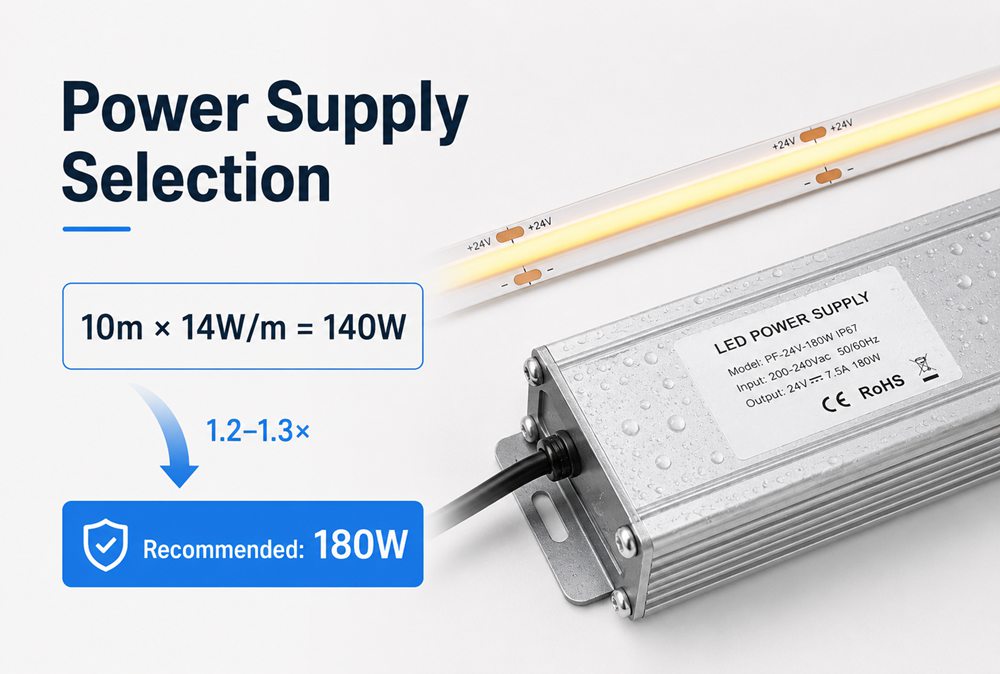
Power Supply Capacity ≥ Total LED Strip Power × 1.2–1.3
For example:
A COB LED Strip installation:
Length: 10 meters
Power: 14W/m
Total power:
10 × 14W = 140W
Recommended power supply:
Around 170W–180W
Using an undersized power supply may cause:
- Voltage instability
- Reduced brightness
- Excessive power supply heating
- Shorter system lifetime
For commercial applications, choosing a reliable power supply is just as important as selecting a high-quality COB LED Strip.
Voltage Drop and Maximum Installation Length
Voltage drop is another important factor that should be considered, especially for long LED Strip installations.
When electrical current travels through the PCB circuit, voltage gradually decreases along the strip length. As a result, the end section of a long LED Strip may become slightly darker than the beginning.
This issue is more noticeable with:
- Higher power LED Strip
- Longer installation distances
- 12V systems
Common solutions include:
- Choosing 24V COB LED Strip
- Reducing the length of each power feed
- Adding power injection points
- Using suitable PCB designs
Compared with 12V products, 24V COB LED Strip generally provides better performance for longer installations because it operates with lower current.
For more information about voltage selection, refer to:
12V vs 24V COB LED Strip: How to Choose the Right Voltage for Your Project
Installation Recommendations for Different COB LED Strip Applications
Different lighting projects have different requirements for brightness, installation space, operating time, and thermal management.
A COB LED Strip solution suitable for cabinet lighting may not be the best choice for commercial or architectural applications.
Selecting the right combination of COB LED Strip power level, aluminum profile, and voltage helps achieve better lighting performance and long-term reliability.
The following table provides general installation recommendations for common COB LED Strip applications.
| Application | Recommended Installation |
| Kitchen cabinet lighting | Low to medium power COB LED Strip + aluminum profile |
| Wardrobe lighting | Slim aluminum profile + COB LED Strip |
| Commercial display lighting | High brightness COB LED Strip + aluminum profile |
| Architectural lighting | 24V COB LED Strip + proper thermal management |
| Indirect lighting | High output COB LED Strip with suitable heat dissipation |
Common COB LED Strip Installation Mistakes

Many lighting problems are not caused by the LED Strip itself, but by incorrect installation decisions.
Common mistakes include:
1. Installing high-power COB LED Strip without considering heat dissipation
High brightness products generate more heat and require better thermal management.
2. Selecting an insufficient power supply
A power supply working close to maximum capacity for long periods may reduce system reliability.
3. Ignoring voltage drop in long installations
Long-distance installations should consider voltage selection and power injection methods.
4. Choosing brightness without considering installation conditions
The brightest COB LED Strip is not always the best solution. The correct product depends on the application and installation environment.
Conclusion
A successful COB LED Strip installation requires more than selecting a high-quality LED Strip.
The final lighting performance depends on the complete system design, including:
- Proper heat dissipation
- Suitable aluminum profile selection
- Correct power supply capacity
- Appropriate voltage selection
- Installation environment
For decorative applications, installation requirements may be relatively simple. However, for high brightness, commercial, and architectural lighting projects, professional installation methods are essential.
A reliable COB LED Strip solution combines the right product specification with proper installation design to achieve stable brightness, consistent color performance, and long-term reliability.
12V vs 24V COB LED Strip: How to Choose the Right Voltage
COB LED Strip vs SMD LED Strip: How to Choose the Right Solution
Related Article
Need an Instant Quote For Your Upcoming Projects?
Send us the details and we will get back to you within 12 hours.